
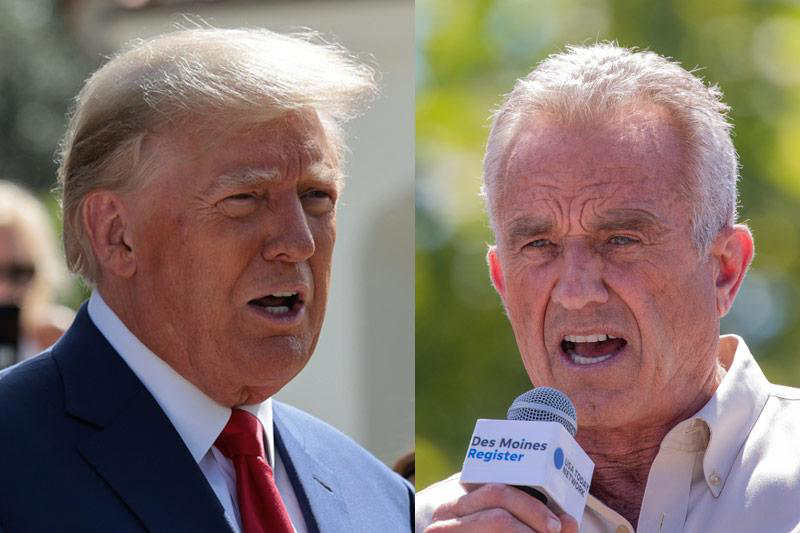
A Department of Health and Human Services spokesperson has publicly responded to reports that tensions between President Donald Trump and Health and Human Services Secretary Robert F. Kennedy Jr. have escalated over the long-debunked notion connecting vaccines to autism. The spokesperson stated that “Secretary Kennedy and President Trump are aligned in their commitment to confronting the chronic disease epidemic affecting America’s children through rigorous, gold-standard science” and that “HHS will continue to pursue evidence-based research to identify the root causes of autism and other chronic diseases, advance prevention strategies, and improve the health of the American people.”
The statement follows a newly leaked account revealing Trump, 80, sharply rebuked Kennedy, 72, during a June 2026 Oval Office encounter. Trump allegedly told his health secretary he would be deemed unsuccessful unless he could prove the scientifically baseless theory linking childhood immunizations to autism. The president expressed dissatisfaction that Kennedy had failed to substantiate this alleged correlation despite leading the department for a year and a half.
MSNBC’s Hayes Brown published an analysis calling it “a surprising accusation, given the centrality of vaccine skepticism to Kennedy’s political brand.” Late-night host Jimmy Fallon also addressed the controversy on his program, joking about the president’s frustration.
The June confrontation stunned Kennedy, a leading vaccine skeptic in America. It marked at least the second occasion Trump had pressed the issue. During a May luncheon at Trump’s Virginia golf property, the president questioned Kennedy about his progress investigating the supposed autism link and accused him of developing the “yips” due to his reluctance.
Obsession With a Discredited Theory
Trump has championed COVID-19 vaccination efforts and claimed credit for Operation Warp Speed, indicating he is not as fundamentally opposed to immunizations as Kennedy. Nevertheless, the president has consistently questioned childhood vaccination programs and repeatedly suggested autism might be connected — a notion lacking any scientific support. Trump is so focused on this subject that he “steers nearly every conversation” with Kennedy back to it. He has also promoted the unsubstantiated claim that Tylenol use during pregnancy may trigger autism.
White House spokesman Kush Desai defended the administration’s stance, asserting that parental worries about increasing autism diagnoses had been dismissed or ridiculed, and that officials remained dedicated to examining them through stringent scientific methods.
Dramatic Policy Shifts Follow Private Clashes
The internal discord has corresponded with major policy reversals. Trump signed an executive order in May directing a dramatic reduction in vaccines administered to American children. The directive endorsed a department analysis proposing that standard childhood immunization requirements be trimmed from 17 vaccines to 11. Trump has also considered breaking up the measles, mumps and rubella (MMR) vaccine into three individual injections, despite the absence of any scientific rationale and extensive research demonstrating no MMR vaccine-autism link.
Public health authorities caution that serious consequences have already emerged. This year is witnessing unprecedented measles infections — more than any year since the disease was deemed eradicated in the United States in 2000. Measles, pertussis and other dangerous infectious illnesses are appearing predominantly in unvaccinated, otherwise healthy people.
A Department of Health and Human Services video distributed in September 2025 provoked fierce condemnation from the Infectious Diseases Society of America (IDSA) for portraying nutritious food, exercise and sanitation programs as alternative options to vaccination. The organization’s president, Dr. Tina Tan, said in a public statement that Americans deserve access to evidence-based information and safe, effective vaccines. The group emphasized that decades of declining infectious-disease mortality occurred only after vaccines were developed and broadly adopted.
Contentious Appointment and Ongoing Scrutiny
Kennedy’s appointment sparked controversy from the beginning. The Senate confirmed him on February 13, 2025, in a 52-48 vote as the 26th secretary of the department, which manages $1.7 trillion in federal expenditures. Supreme Court Justice Neil Gorsuch administered his oath, and Trump issued an executive order on childhood chronic disease that same day. Kennedy, who holds no credentials as a medical doctor, scientist, or health researcher, has spent years questioning vaccine safety and embracing fringe theories — including that Wi-Fi signals cause cancer, that coronavirus vaccines were engineered to control populations via computer chips, and that HIV infections do not cause AIDS. His anti-vaccine advocacy has been linked to a catastrophic 2019 measles outbreak in Samoa that killed 83 people.
His remarks as secretary have continued attracting criticism. During a September 2025 Senate hearing, he asserted CDC data indicate approximately 76 percent of Americans suffer from chronic disease and, when Sen. Mark Warner inquired about COVID death totals, replied he did not believe anyone knew. Dr. Richard Besser, a former acting CDC director, challenged multiple Kennedy claims, telling PBS News that over a million lives were saved in the United States because of COVID vaccines.
The White House had previously pressured Kennedy to moderate his public skepticism toward vaccines amid fears it might damage Republicans in November’s midterm elections. The reported June episode indicates those strains have persisted — and that Trump demands tangible outcomes.