
Secretary of State Marco Rubio received a private audience with Pope Leo XIV on May 7, 2026, at the Vatican, in a significant diplomatic development that left Vice President JD Vance absent from the high-profile encounter. The arrangement marked a dramatic shift in the administration’s Catholic outreach and intensified speculation about a deepening rivalry between the two prominent Catholic figures in President Trump’s inner circle.
Rubio’s three-day visit to Rome included sessions with Vatican Secretary of State Pietro Parolin and Italian Prime Minister Giorgia Meloni. The devout Catholic, who regularly attends Mass, met with the American-born pontiff one day before Leo marked his first anniversary as leader of the world’s 1.4 billion Catholics.
The State Department framed Rubio’s mission in measured terms. A State Department spokesperson said Rubio would meet with Holy See leadership to discuss the situation in the Middle East and mutual interests in the Western Hemisphere.
Trump’s Blistering Attacks on the Pope
The Vatican meeting unfolded amid extraordinary tensions between the White House and the Holy See. President Trump stunned many observers by attacking Pope Leo, the first American-born pontiff, after the pope called for peace in the Middle East war and said Trump’s call to destroy Iranian civilization was unacceptable. The president branded Leo as “WEAK on crime, and terrible for foreign policy.”
Trump escalated his rhetoric further on The Hugh Hewitt Show on May 4, accusing Leo of being “fine” with Iran having a nuclear weapon and warning he is “endangering a lot of Catholics and a lot of people.” The pontiff fired back on May 5, saying critics should “do so with the truth,” and flatly rejecting the nuclear claim: “The church has spoken out against all nuclear weapons for years, so there is no doubt on that point.”
The pope also publicly criticized Trump’s sweeping crackdown on immigration, drawing further presidential ire. Christians across the world rallied in support of the pontiff in the wake of Trump’s outbursts, and analysts warned the feud could carry real political costs. Polls conducted in March and April 2026 showed growing disapproval of Trump among American Catholics — an ominous warning sign for a president who won a majority of Catholic voters in the 2024 election.
Vance Frozen Out of Papal Talks
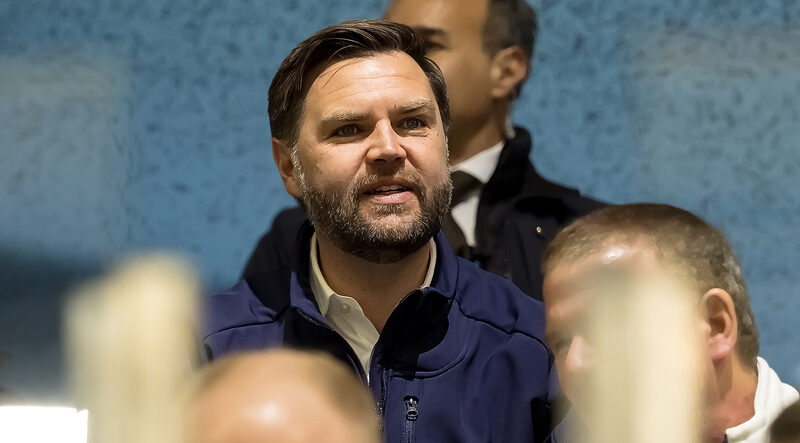
Vance, who converted to Catholicism in 2019, had been positioned as the administration’s natural envoy to the Vatican. But with the vice president nowhere on the guest list, the snub was widely interpreted as fallout from the pope’s reported decision to decline Vance’s invitation to the White House.
The decision to send Rubio alone marked a striking reversal from standard diplomatic protocol and fueled speculation about a growing rivalry between the two Catholic power players in Trump’s orbit. With Leo bristling at Vance’s outreach and Rubio earning the coveted private audience, the Cuban-American secretary of state appeared to hold the upper hand in the administration’s Catholic diplomacy portfolio. The depth of Vatican frustration with Trump became further apparent when Cardinal Pietro Parolin, the Holy See’s secretary of state, publicly defended Leo and criticized the president’s attacks on him. “Attacking him like that or criticizing what he does seems a bit strange to me, to say the least,” Parolin said.
Meloni Caught in the Crossfire
Rubio’s itinerary also included a morning meeting with Meloni on May 8, a session Rubio himself requested, an Italian government source told AFP. The far-right Italian leader had long been considered one of Trump’s closest European allies, but that bond has frayed badly. President Trump insulted Meloni after she defended the Catholic leader, criticizing her as lacking courage.
The president had even threatened to pull U.S. troops from Italy, complaining that Rome “has not been of any help to us” in the Iran war. Italian media framed the meetings in Rome as an attempt to “thaw” relations chilled by Trump’s broadsides.
“Meetings with Italian counterparts will be focused on shared security interests and strategic alignment,” the State Department said.
Cuba and the Western Hemisphere on the Agenda
Cuba loomed as another likely topic of discussion at the Vatican. The Holy See had long played an active role in diplomacy on the island, and Rubio, a Cuban-American, has been leading the Trump administration’s efforts to increase pressure on the communist government in Havana. Vatican officials have historically served as quiet brokers in U.S.-Cuba relations, and the meeting did address the island directly. Rubio disclosed that the U.S. had provided $6 million in hurricane relief to Cuba, distributed through the Catholic agency Caritas, and that Washington had sought to provide an additional $100 million that was refused by the Cuban regime. The two also discussed the recent Vatican visit of several Venezuelan bishops and the humanitarian situation in Sudan.
For the Vatican, the meeting represented a delicate balancing act: engaging substantively with Washington on global crises while not appearing to capitulate to a White House that has publicly humiliated both the pope and one of Europe’s most prominent Catholic leaders. For Rubio, the visit was an opportunity to position himself as the indispensable bridge between an angry president and an unyielding pontiff, a role that many assumed Vice President Vance would play.
The May 7 audience ultimately produced cautious, measured results rather than a genuine thaw. Rubio and Pope Leo met for more than 45 minutes, with the secretary of state inside the Apostolic Palace for over two hours in total. The Vatican described the talks as “cordial” and said the shared commitment to fostering good bilateral relations was reaffirmed, but stopped short of any warmer language. In a symbolic exchange of gifts, the pope presented Rubio with an olive-wood pen, noting it was the plant of peace, while Rubio gave Leo a miniature crystal football bearing the State Department seal.
With the vice president sidelined and the secretary of state ascendant, the contours of Trump’s Catholic diplomacy shifted dramatically — and the rivalry between two of the administration’s most prominent Catholic voices has only intensified.