
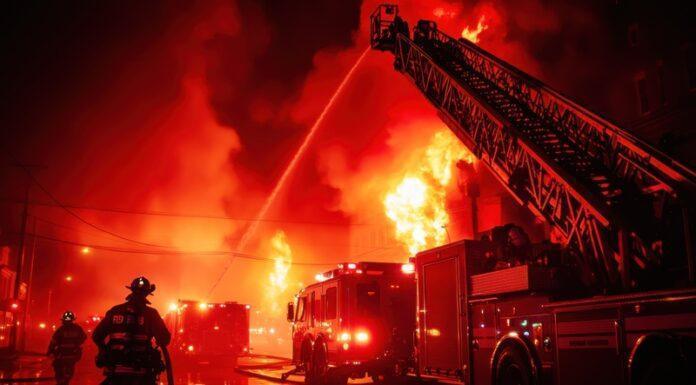
Fire tore through the newborn nursery of the largest government hospital in Pakistan’s capital on August 26, 2026, killing 14 babies. Rescue officials initially pointed to an air-conditioning compressor, saying it exploded inside the room where the infants were being treated.
At least 15 newborns were in the nursery at the Pakistan Institute of Medical Sciences (PIMS) in Islamabad when the fire started. The first emergency call went out about 6:45 a.m., the Islamabad district administration said. The blaze never spread past the nursery, which sits inside the hospital’s gynecology ward, and no other part of the sprawling public facility was touched. Firefighters brought it under control shortly after arriving and then began cooling the site, local media reported. Security personnel took up positions outside the Mother and Child Health (MCH) ward, where ambulances also lined up as word spread and families rushed in.
Grief and Anger Outside the Ward
Police, too, were deployed at the hospital. Parents, grandparents and other relatives pushed toward the maternity building, some collapsing in tears, others shouting for accountability. The question they pressed was one no official could yet answer: what had set alight a nursery holding the hospital’s frailest patients.
“The scene is unbearable in the ward,” Noreen Khan, a senior nurse at PIMS, told CBS News by telephone. The babies who died, she said, had been alive for barely a day or two.
Amir Abbasi’s newborn nephew died in the fire — the first boy born into his family in years, he said. Only a day earlier, he recalled, he had touched the baby’s face and held his hand. Nearby, another mother wept outside the hospital, calling for justice and pleading for her child to be returned to her.
Three days before the fire, a woman identified by the Associated Press as Mrs. Mohammad Sami had given birth. Her infant was in the nursery, under intensive care, when the flames broke out. There were no words for it, she said, and no one she could blame; the only thing she knew was that her child was gone. Hospital staff told the relatives that the bodies would be released once the necessary documentation was completed, according to Sami.
The loss was not shared by every family in the building that morning. Muneeba, visiting relatives at the hospital, said she got out along with her nephew and her sister-in-law. “Thank God our baby is safe,” she told CNN. A three-day-old baby had been killed, another father told reporters outside the hospital, saying no one could understand the pain he was carrying.
The Nurse Who Ran Into the Nursery
The nurse who carried the one surviving baby out of the burning room has been named as Razia Noreen. A 51-second CCTV clip that circulated online shows her running into the nursery and emerging eight seconds later with the newborn, before flames and smoke drove her back. The baby’s aunt has disputed the account, telling one Pakistani outlet that she carried the child out herself.
By August 31, Prime Minister Shehbaz Sharif had announced that Noreen would receive the Sitara-i-Khidmat, or Star of Service, and 10 million rupees, about $36,000.
Speaking in tears to private broadcaster Samaa TV on August 30, Noreen said: “I did not do it for a reward. I love children, and caring for them is my passion.” Separately, she said: “I cannot sleep. Those babies do not let me sleep.” On September 1 she told the Associated Press: “I wanted to save the others.”
Inquiries Ordered and a Health Secretary Removed
The Islamabad district magistrate appointed a multi-agency fact-finding committee and gave it 24 hours to report back, according to a government notification. The panel was asked to determine the fire’s cause and the way it spread, to establish whether the nursery had adequate fire-safety measures in place, and to judge how the emergency response was handled.
Those were the same questions families were shouting at the hospital gates. Did the nursery have working firefighting equipment, relatives asked, and how had an air-conditioning unit in a room of newborns been allowed to fail so catastrophically?
Kamal, the health minister, said he would supervise the inquiry himself as he flew in from Karachi to the capital. The health director-general and the federal health secretary had already reached PIMS, he told Pakistan’s Geo News. Officials, he said, were in contact with the affected families, and the first task was to support the parents and return their babies to them.
Federal Health Secretary Aslam Ghauri was suspended as Sharif went further, also constituting a separate high-level inquiry committee under former interior secretary Shahid Khan.
An interim report from that panel was due within 48 hours, with a final report to follow within five days. A Capital Development Authority fire brigade report found that emergency exits at the ward were permanently closed and evacuation routes obstructed, and said hospital security staff hindered firefighters during the initial response. PIMS rejected that account, saying all emergency exits were open and functional during the fire and that staff used 35 fire extinguishers and other safety equipment against the blaze.
The hospital produced a preliminary account of its own, timing the first spark inside the nursery at about 6:38 a.m. Oxygen points at each incubator turned it into a fast-moving fire within seconds, that account said, and the infants were killed by burns and the loss of their oxygen supply. It blamed a nebulizer attached to an incubator to monitor oxygen levels, ruling out both an air-conditioning compressor explosion and a short circuit — the third account of the cause in as many days, after the compressor and, from one federal minister, a short circuit.
The government’s own interim report reached no such conclusion. “The precise ignition source remains technically unresolved,” it found, having examined air conditioners, incubators, warmers and electrical faults. Working from CCTV, the panel timed the ward’s collapse at about two minutes: a charge nurse, Nasreen, ran out for help at 6:38:15 a.m., and Staff Nurse Razia Noreen entered at 6:38:56 and emerged eight seconds later carrying a baby. Capital Emergency Service logged its first call at about 6:54 a.m. — 16 minutes after ignition — dispatched a minute later and arrived at roughly 7:01 a.m. The facility had no detailed standard operating procedures, no emergency drills and no formal fire-safety training, the inquiry found, and fewer staff were on hand than the duty roster required, with no supervising staff present.
Its final report, which is to settle the cause, has yet to be delivered. The 14 babies were buried in their families’ home towns on Thursday, August 27.
On August 30, authorities suspended eight hospital officials — among them the hospital’s executive director, the head of the neonatal department and the director-general of Islamabad’s emergency services — and launched criminal proceedings, acting on Sharif’s orders after the preliminary inquiry. The government also approved legal action against the private firm contracted for the hospital’s security. Dr Mohammad Salman, chief executive of the National Institutes of Health, took over as acting executive director.
On August 31 the Islamabad High Court took up petitions seeking a judicial inquiry. Chief Justice Sardar Muhammad Sarfaraz Dogar called the fire a terrible incident, said the loss of 14 children was extremely serious, and gave the federal government five days to explain what accountability had been fixed on the hospital’s executive director. Told that a petitioner wanted a judge to run the inquiry, he said that if the matter came before the court he would ask one of his judges to look into it.
A charity official said a two-month-old abandoned baby, informally named Ali by staff, was also killed in the August 26 fire. In an account reported on August 30, the official said the infant was handed to the Edhi Foundation and buried as an “unclaimed body” at E-11 graveyard at 2 p.m. the same day. Hospital sources said the baby had been born to a 15-year-old mother whose family left after being unable to provide marriage documentation. Whether he is counted among the 14 is unclear; no official toll has been revised.
Shock Ripples Across Pakistan
Grief over the deaths traveled far beyond the hospital compound. Sharif ordered an immediate investigation and expressed sorrow, saying a tragedy that claims children is a loss that cannot be repaired. Interior Minister Mohsin Naqvi also voiced sorrow over the fire.
President Asif Ali Zardari offered condolences to the families and described the deaths as heartbreaking and impossible to make good. He demanded that whoever was at fault be named and prosecuted, and pressed hospitals across the country to put effective fire-safety measures and emergency procedures in place, singling out wards that care for newborns.
The largest government-run hospital in Islamabad, PIMS draws patients from across the region who cannot afford private care. Its maternity building, where the fire broke out, delivers and treats infants around the clock.
Activists gathered outside the Mother and Child Health ward on August 27, lighting candles and laying flowers in protest at the infants’ deaths.
For the parents who arrived that day to visit babies born within the past few days, everything was reduced to paperwork and a body to carry home. Whether anyone is held responsible now depends on what the inquiries conclude about the cause, the alarms and the response — and on whether the safeguards Zardari demanded ever reach the wards where the youngest patients slept.