
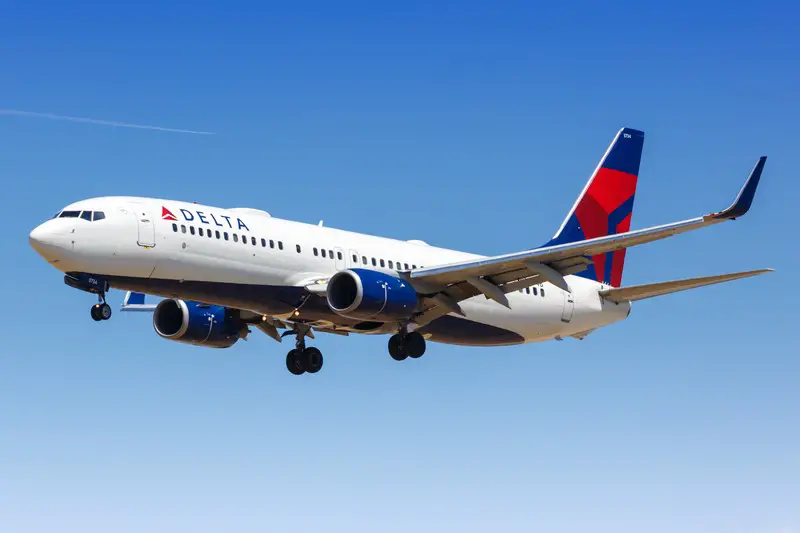
Midway through a cross-country run from Los Angeles to Boston on August 25, 2026, the captain of a Delta Air Lines jet carrying 147 passengers keyed his microphone and told air traffic controllers that the medical emergency on board was him.
Flight 437, a Boeing 757, was roughly three and a half hours along when the crew gave up on the route east and pointed the jet toward Detroit Metropolitan Wayne County Airport. Air traffic control recordings caught what came next: the ailing pilot breaking the news himself, in the level, unhurried delivery of a man working down a checklist.
“This is the captain. I am the one who is ill,” he told controllers, adding that he planned to taxi the jet to the gate and then needed to get to a hospital.
Controllers in the Detroit tower did not hesitate. Flight 437 was cleared to exit at Yankee Two, the quickest path from the runway to the gate.
Diverted Three and a Half Hours In
The airplane was a 1997-built Boeing 757-200, tail N707TW. It left LAX around 10:45 a.m. PT on August 25 for Boston Logan International Airport, a flight scheduled to take roughly five and a half hours. It never arrived on that schedule.
The Federal Aviation Administration (FAA) said the airplane landed safely in Detroit after the crew declared a medical emergency involving the pilot. Touchdown came on Runway 22L at 5:38 p.m. ET, and the 757 was at gate A10 five minutes later; the gate assignment had briefly flipped to A13 until a controller flagged it as too small for a 757. Airport firefighters met the diverted plane, according to the Wayne County Airport Authority, and the captain was taken to a local hospital afterward.
Delta spokesperson Drake Castañeda told the Boston Globe that the captain had “stomach pains,” the first official description of a symptom. The airline has not named him or released a diagnosis, and as of September 1 there was still no official medical update.
An aviation writer posting as JonNYC said he had heard the illness was appendicitis, with surgery the next day and a good outlook — then immediately added, “not confirmed at all.” None of that has been confirmed by Delta, the FAA or the hospital, and reports of a burst appendix circulating on forums remain unverified.
Why the Sick Pilot Was Talking
To anyone listening to the tape, the setup can sound backward — the sick pilot on the radios while an emergency unfolds. Aviators say it is exactly right.
Airline crews divide the work so that whichever pilot is not flying picks up the radio calls, leaving the other free to concentrate entirely on the airplane. That was how Matthew “Whiz” Buckley, a former military and commercial aviator, explained it to CBS News Boston. The crew did exactly what the book calls for, Buckley said, since standard procedure is an immediate diversion to the closest suitable airport whenever a pilot is incapacitated or expects to lose the ability to fly safely.
That is how it played out. Two days after the diversion, Delta spokesperson Drake Castañeda told the Boston Globe that the first officer had stepped in to land the jet in Detroit while the captain worked the radios.
The recording spread across aviation accounts on Facebook, Instagram and X; the Boston Globe traced it to a Facebook page called Flight Simulator Fantasy, which tracks controller audio. It drew attention to a decision most of the people on board never noticed. There was no cockpit struggle and no plunging descent — just a change of course and a steady voice explaining the reason for it.
Passengers Reach Boston 90 Minutes Late
Delta confirmed the aircraft landed without incident in Detroit and said a replacement crew took over to finish the trip, with the ill captain remaining behind. The jet left Detroit at 7:17 p.m. and reached the gate at Logan at 9:04 p.m., the airline said, roughly an hour and a half later than originally scheduled.
The airline apologized to travelers for the disruption but declined to discuss the pilot’s condition. “We apologize to our customers for this disruption in their travels,” Delta said in a statement.
Flying commercially in the United States requires current medical certification, and airlines build redundancy into every cockpit for exactly this kind of moment. Flight 437 had two qualified pilots at the controls. Landing it took only one.
A Similar Scare in June
Nobody on board was hurt in the Detroit diversion — a far quieter ending than an incident earlier this year that pulled passengers themselves into a cockpit crisis.
That happened on June 24, when travelers aboard Flight AC7664 helped restrain a pilot who appeared to suffer a seizure in the air. The De Havilland Q400, operated by Air Canada regional partner PAL Airlines, was carrying 61 passengers from Newark, N.J., to Halifax, Nova Scotia, and the struggle lasted about 40 minutes.
Rodney McDonald, a passenger on that flight, told ABC News the aircraft lurched again and again, as though someone had jolted the controls. A flight attendant hauled the pilot out of the flight deck and into the aisle, where McDonald and four other travelers pinned him down with seatbelts, with help from a nurse on board. The first officer took the controls and landed the plane safely in Boston.
Two flights this summer, two pilots who could not finish the job. Both times, the second seat in the cockpit did what it exists to do.