
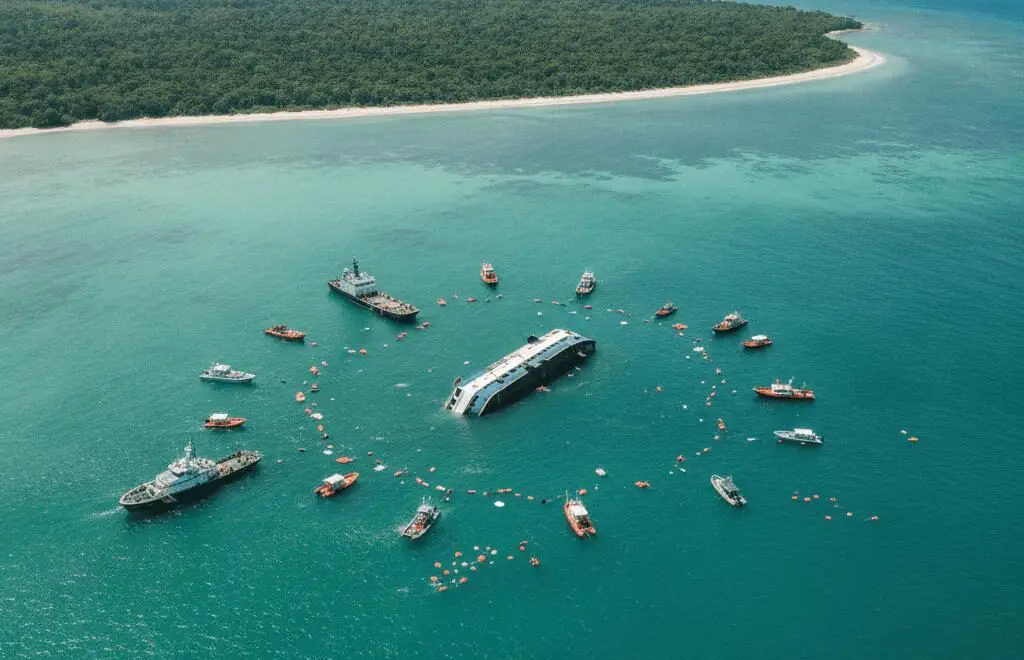
A government ferry disaster in Zimbabwe has claimed at least 93 lives, with the death toll climbing as rescue operations continue across the sprawling expanse of Lake Kariba following the vessel’s capsizing on Aug. 11, 2026. Provincial Affairs Minister Marian Chombo said on Aug. 18 that nine additional bodies have been recovered since the weekend, bringing the confirmed fatalities to 93. Of the 83 victims identified so far, 39 were children.
President Emmerson Mnangagwa has declared a state of disaster following the accident. The ferry, now named Mbuya Nehanda, was carrying far more people than its 90-person capacity allowed. Estimates now suggest at least 168 people were actually aboard when the vessel overturned, though official records showed only 114 adults plus five crew members.
Search Expands as Bodies Drift Toward Border
Bodies are now being recovered further from the scene, with some drifting in the direction of Zambia, according to Minister Chombo. DNA testing may be needed to identify some bodies, she added. A memorial service was held at a stadium in Kariba last week. Sixty-seven people were rescued, though the gap between that figure and the estimated passenger count leaves dozens of fates still unknown.
An underwater search-and-rescue team was deployed to scour the lake, while ZBC broadcast footage showing speedboats rushing toward what appeared to be the capsized vessel as a helicopter circled above. Police announced initial casualty figures on the social media platform X but have not provided information on how many people remain injured or missing.
Passenger Manifest Failed to Capture True Count
The full human toll may never be precisely known because ticketing records reflected only adults who purchased fares. Children below the ticketing age could have traveled without appearing in any manifest, creating an accounting gap that has left investigators uncertain about exactly how many people were aboard when the ferry went down.
State broadcaster ZBC reported children were included in the fatalities, but officials have not yet provided details breaking down victims by age. Officials confirmed the ferry carried a passenger load exceeding its legal limit by no fewer than 24 people, and the disaster happened during what should have been a roughly five-hour crossing to the town of Kariba.
Onlookers Voiced Concern Before Departure
Before the ferry set out, Mutsa Murombedzi, a local member of Parliament, filmed the departure and shared the video online. The footage showed something ominous: as they watched the farewell, people on the shore could be heard voicing concern over whether the old ferry would withstand the heavy waves moving across the water that day.
Murombedzi said residents of remote villages rely on the government-operated ferry as crucial infrastructure. For people living along the lake’s edge who have limited alternatives for getting into town, this vessel serves not as recreation but as an essential connection to medical care, schools, and markets that cannot easily be accessed by road.
Africa’s Largest Reservoir by Volume
The tragedy occurred on one of the continent’s largest lakes. Ranked as the planet’s largest man-made reservoir by volume, Lake Kariba extends over 200 kilometers — approximately 124 miles — from end to end, and spans as much as 40 kilometers, about 25 miles, at its broadest sections. The reservoir came into existence during the late 1950s and early 1960s after engineers built a dam to hold back the Zambezi River, submerging the valley beyond. Zimbabwe and Zambia share the lake, divided by an international boundary that runs down the middle of its waters.
Its vast and deep waters now present a challenge for search teams working to locate additional victims and resolve the fate of those still unaccounted for.
As of mid-August, authorities had not issued an official statement explaining why the ferry capsized. Witness accounts describing an overloaded boat, its deteriorating condition, and choppy lake conditions paint a troubling picture suggesting the voyage was imperiled from the outset.