
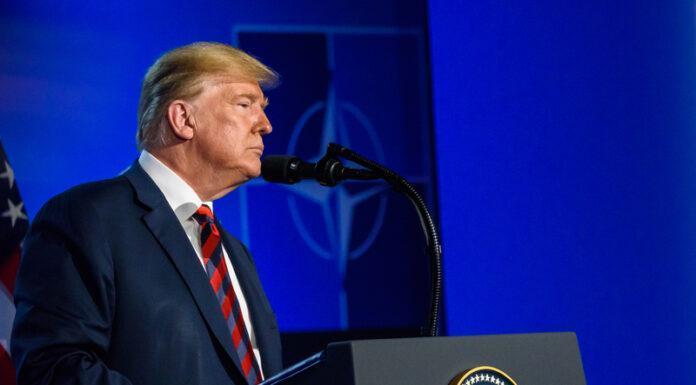
President Donald Trump handed his critics a ready-made talking point on July 8, 2026, when he pointed directly at Ukrainian President Volodymyr Zelensky during a NATO summit press conference in Turkey and asked assembled reporters, “You have a question for President Putin, please?” — then, after reporters reacted, doubled down with, “Do you have a question for President Putin, not Zelensky, Putin.” The 80-year-old commander in chief appeared to confuse the Ukrainian leader with Russian President Vladimir Putin — the man whose forces have been waging war against Ukraine for years — in front of a room full of journalists who were quick to flag the error.
A Gaffe Two Years in the Making
The slip was all the more striking for its historical echo. Almost exactly two years to the day before Trump’s blunder, former President Joe Biden made the identical mix-up at a NATO summit — that one in Washington, D.C. — calling Zelensky “President Putin” in what became a defining moment of scrutiny over Biden’s fitness for office. Biden was 81 at the time, about a year older than Trump is now, and the episode fueled intense public debate about whether the then-president was capable of carrying out his duties.
On July 8, several reporters in the room wasted no time in pointing out that Trump had repeated the very same mistake. Rather than acknowledge the slip directly, Trump attempted to reframe it, telling the gathered press corps he was soliciting questions for Putin — not Zelensky — and invited a Ukrainian reporter to participate. When that reporter asked when Putin would end the war, Trump replied, “That’s a good question. I don’t think I’ve ever asked him that question.”
Trump compounded the chaotic atmosphere later in the same event when he referred to Iran as “the Islamic Republic of Japan,” adding a second verbal stumble to an already headline-generating press conference.”
A Major Win for Ukraine Amid the Chaos
Lost somewhat in the noise of the gaffes was a genuinely significant policy announcement. Trump confirmed on July 8 that the United States will allow its Patriot air defense systems to be manufactured overseas, opening the door for Ukraine to produce the technology domestically. Zelensky has pursued a license to manufacture Patriot systems for some time, given that the weapons are expensive, in high demand globally, and take considerable time to produce.
Trump framed the decision in characteristically direct terms, saying the U.S. would show Ukraine how to build the systems. He also praised Zelensky during their bilateral meeting, describing the Ukrainian leader as having done “an amazing job” and proving himself “very effective” in the war.
The license addresses a longer-term need, however. As of July 11, Ukraine’s existing stockpile of Patriot interceptor missiles had already run dry, Zelensky said, and he is preparing changes to Ukraine’s diplomatic efforts aimed at accelerating weapons deliveries from allies in the meantime.
Separately, NATO’s closing declaration pledged €70 billion ($80 billion) in military equipment, assistance, and training for Ukraine in 2026, with allies affirming “sovereign commitments to sustaining at least equivalent levels” of support in 2027.
A Complicated Diplomatic Backdrop
The summit comes against a fraught diplomatic backdrop stretching back months. On June 14 — Trump’s 80th birthday — both Putin and Zelensky held separate phone calls with the president. The conversation with Putin ran for nearly 60 minutes, as Russian presidential aide Yuri Ushakov confirmed, and Trump emphasized the need to end hostilities and expressed readiness to pressure European allies and Kyiv toward a settlement. American envoy Steve Witkoff and Trump’s son-in-law Jared Kushner were expected to travel to Russia following those conversations, Ushakov indicated at the time.
Putin, for his part, suggested that if Zelensky wanted a face-to-face meeting, he should come to Moscow.
Relations between Washington and Kyiv have been turbulent. In February 2025, a confrontational meeting at the White House between Trump and Zelensky drew widespread attention when Trump rebuked the Ukrainian leader for not pursuing peace talks sooner. Trump has repeatedly assigned blame for the war’s enormous human cost to multiple parties. On April 14, 2025, he named Putin, Biden, and Zelensky as jointly responsible for what he described as “millions of people dead,” though the war’s casualties are estimated in the hundreds of thousands, not the millions he claimed.
The Shadow of Sumy and Ongoing Violence
The NATO gathering also unfolded in the shadow of a devastating Russian strike on the Ukrainian city of Sumy in April 2025 that killed 35 people and injured 129 others — the deadliest attack on civilians in Ukraine that year. Trump initially described the strike as “terrible” but suggested he had been told Russia made a mistake. Moscow claimed it had targeted a gathering of Ukrainian soldiers, alleging 60 were killed, though no evidence was provided. Ukrainian media reported that a medal ceremony for military veterans had been taking place in Sumy that day. Zelensky subsequently dismissed the city’s regional chief for having hosted the event.
NATO Secretary General Mark Rutte, who traveled to Odesa, Ukraine, in a show of solidarity with Kyiv following the strikes, condemned what he called a “terrible pattern” of attacks on civilians and declared without equivocation that Russia bore responsibility for starting the war.
Russia first invaded Ukraine in 2014 and launched a full-scale invasion in 2022. The conflict, now grinding through its fifth year, has resisted every diplomatic push to bring it to a close, and the July 8 press conference, memorable for all the wrong reasons, did little to suggest that it is about to change.