
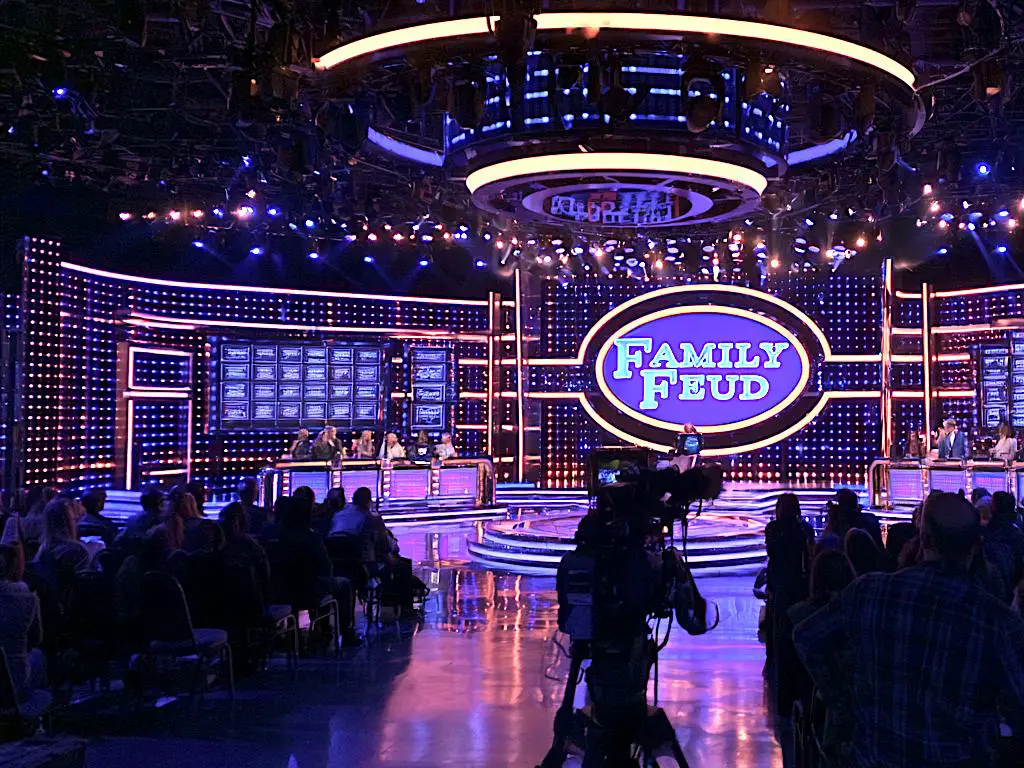
By May 2023, comedian Steve Harvey had spent 13 years behind the podium of “Family Feud,” making a living from his signature brand of manufactured astonishment. His shtick depended on acting perpetually shocked by risqué answers to survey questions seemingly crafted to elicit exactly those responses. The formula had sustained his tenure as host and kept audiences laughing for over a decade. Then came the Tracy incident — a brief exchange that exposed the hypocrisy baked into the entire production and sparked furious pushback from viewers who recognized the double standard at play.
The setup was routine enough. Harvey asked Tracy what object people might still be holding when they drift off to sleep. After a visible pause, she nervously replied, “themselves.” Harvey pounced immediately. He brandished the card bearing the program’s name, drew attention to the word “Family,” and reminded Tracy that the show airs during daytime hours — a scolding delivered in front of a studio audience and cameras alike.
Then the answer board lit up. Tracy’s response appeared under the sanitized label “appendage,” revealing that the survey data had validated precisely what she suggested. Harvey, visibly caught off guard, questioned aloud what the word even referred to. The host who moments earlier had shamed a contestant for an allegedly inappropriate guess discovered the answer was legitimate all along. The reversal was complete.
The Architecture of Innuendo
What the episode illuminated was not a single misstep but the structural contradiction holding up the entire show. “Family Feud” operates on deliberate ambiguity. Survey prompts about what adults clutch at bedtime invite interpretations far removed from stuffed animals — that’s not a bug, it’s the core feature. The suggestive phrasing generates the innuendo that Harvey then performs astonishment over. His scandalized reactions are the product being sold, wrapped around questions engineered to produce exactly those moments.
For years this implicit bargain functioned smoothly because everyone understood the game. Earlier episodes featured NSFW guesses that stopped production, triggered gasps, and gave Harvey material for exaggerated shock — moments viewers enjoyed because the theatrical nature was transparent. Contestants took risks, Harvey feigned horror, and the audience laughed at the predictable dance. The moral indignation was performance art, successful only when everyone recognized it as such.
When the Audience Stops Playing Along
Tracy’s appearance shattered that unspoken agreement, and the comment section beneath the Instagram post documented the fracture with remarkable precision. Viewers weren’t offended by sexual innuendo — they objected to a host profiting from that innuendo while publicly shaming the person who delivered it. “The questions leave little to no room for kid friendly thoughts,” one commenter noted. Another wrote, “U ask this types of question n still say it’s FAMILY feud.” A third demanded, “Then why do you form the questions like that!?” The collective complaint formed a coherent accusation: the program baits contestants into suggestive territory, then punishes them for going there.
The power imbalance amplified the problem. Harvey commands the stage with full knowledge of how the show operates. Contestants arrive without that context, guessing blindly at survey results while cameras record their every word. When Harvey shares a laugh over a clever innuendo, the dynamic feels collaborative. When he humiliates someone for an answer the game itself endorsed, the exchange tips into something uglier — a powerful figure weaponizing his platform to embarrass a vulnerable participant, all while being factually wrong.
Manufactured Shock as Moral Currency
The incident itself was trivial — a fleeting moment in one episode of thousands. Yet it serves as a revealing case study in how daytime television’s machinery usually stays concealed. The genre thrives on spontaneity that’s actually scripted, surprise that’s structurally inevitable. When those mechanisms become visible, as they did here, audiences suddenly confront the artifice beneath the entertainment. Once the construction shows, enjoying the illusion becomes harder.
The central absurdity is that Harvey’s astonishment has never been credible. Nobody hosts a program centered on sexually suggestive survey questions for 13 years while remaining genuinely scandalized by the answers. His shock is theater, and audiences have implicitly accepted it as performance. But theater only succeeds when it maintains internal consistency. The routine collapses when the performer transforms fake innocence into a cudgel — when pretending to be appalled becomes justification for humiliating someone else. At that juncture, viewers are asked to laugh at the contestant rather than with the host, and a significant portion refused.
The speed and intensity of the backlash signal something meaningful about evolving audience expectations. The program’s format has doubled down on risqué content, making clear that innuendo formed the foundation rather than an accident. Viewers had accepted that reality. What they rejected was a host who capitalizes on sexual suggestiveness while pretending to condemn it — and who directs that condemnation at contestants instead of at the deliberately provocative questions.
The controversy, minor though it was, points toward a broader renegotiation of power dynamics in entertainment. The traditional model positioned the host as unchallengeable authority whose reactions set the tone. The Instagram commenters flatly rejected that framework, insisting that whoever constructs the game bears accountability for what it produces. They refused to let Harvey position himself as an innocent bystander when he’s actually the central performer. It’s a small rebellion conducted in social media vernacular, but it represents a genuine transformation: audiences now respond publicly and maintain evidence.
Harvey’s longevity demonstrates the durability of his appeal, and the show’s formula had survived countless controversies by 2023. But this particular moment offers a compact lesson about the limits of performed innocence. Building a career on theatrical shock is viable. Converting that shock into laughter, and laughter into enduring success, has proven achievable. What fails, apparently, is directing that performance at someone in a weaker position while expecting continued audience approval. When Harvey gestured toward the word “Family,” he wasn’t upholding values. He was invoking standards his own show systematically undermines for profit — and the answer board, unmoved by his act, simply displayed the facts.