
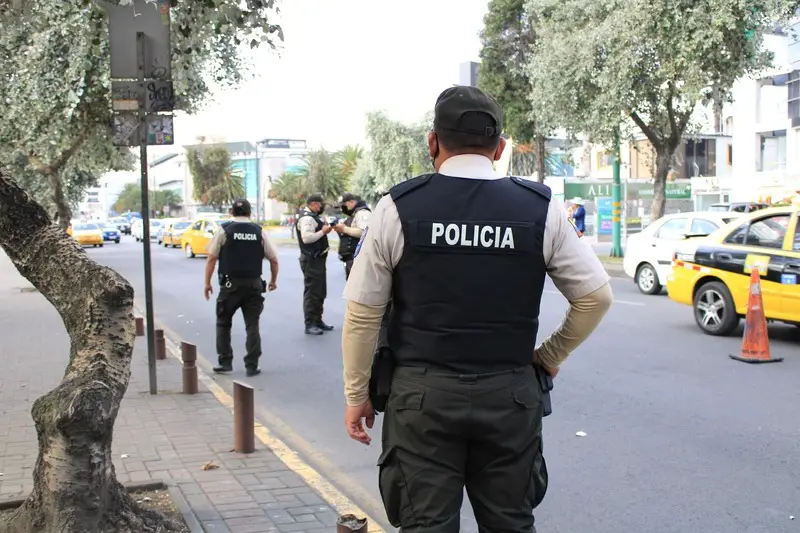
Lady Gissela Pachar Huanga was traveling by car to a gym in Machala on Monday, May 11, 2026, when gunmen opened fire in broad daylight, killing the criminal court judge in southwestern Ecuador. Her two assigned bodyguards were not present during the attack in the capital of El Oro province, which borders Peru, according to local police.
A police source told AFP (Agence France-Presse) on May 14 that the judge had received threats and was murdered in retaliation for the release of gang members. Police have since named Los Lobos, designated a foreign terrorist organization by the United States, as the prime suspect in the killing.
Ecuador’s Judicial Council condemned the attack Monday as a “serious attack against justice and the rule of law in Ecuador” and demanded a full investigation. The killing struck at the heart of a judiciary already under siege in a small Andean nation where cocaine cartels have turned the country into one of Latin America’s deadliest places.
Sixteen Killed Since 2022
At least 16 judges or prosecutors have been killed in Ecuador since 2022, according to Human Rights Watch. In October 2025, a gunman riding a motorbike shot down a judge as he walked his children to school, a brazen attack that briefly shocked the country before it slipped into the steady drumbeat of cartel violence.
The Ecuadorian Judges’ Association condemned the murder on Tuesday, writing on social media: “Without independent judges, there is no justice.”
Around 70 percent of the cocaine produced by Colombia and Peru — the world’s largest and second-largest producers — is shipped through Ecuador’s ports and Pacific coastline. That makes the country’s courts, prisons, and prosecutors’ offices high-value targets for the trafficking organizations that depend on a corrupted or terrorized justice system to keep their product moving.
A Protective Detail That Wasn’t There
Judge Pachar had been flagged as a target. The Council of the Judiciary confirmed that protective measures had been assigned to her, but acknowledged a critical failure on the day she died.
“It should be noted that the judge had previously been assigned protective measures; however, these measures were not in place at the time of the attack,” the council said in a translated statement.
The gap between the threats Pachar faced and the security she received underscores a problem prosecutors and judges across Ecuador have raised for years: assigned protection often exists more on paper than on the street. By the time her car reached its destination, the judge was dead, and the gunmen were gone.
Noboa’s Hard-Line Bet
Pachar was killed during a state of emergency declared specifically to combat organized crime—a fact critics have noted underscores the government’s strategy’s limitations.
President Daniel Noboa, one of President Trump’s staunchest allies on the continent, has staked his presidency on confronting the cartels since taking power in November 2023. He has deployed soldiers on the streets and inside prisons, launched dramatic raids on drug strongholds, and declared frequent states of emergency. Human rights groups have fiercely criticized the tactics, warning of abuses by security forces operating with expanded powers.
Homicides have climbed despite the crackdown, reaching a record 9,216 violent deaths in 2025. The state of emergency under which Pachar was killed was supposed to suppress exactly the kind of contract-style assassination that ended her life.
American Commandos on the Ground
The deteriorating security picture has drawn Washington deeper into Ecuador’s fight. In early March, the United States and Ecuador launched joint military operations against organizations designated as terrorist groups. American commandos recently joined Ecuadorian troops in Operation Lanza Marina, a mission targeting a compound believed to serve as a staging ground for high-speed boats linked to Los Choneros, one of the country’s most violent gangs.
Two U.S. officials, speaking on the condition of anonymity because they were not authorized to discuss the operation publicly, said American forces worked in advisory roles, accompanying their Ecuadorian counterparts as they moved against the site. The mission is part of a broader effort to disrupt maritime trafficking routes that have made Ecuador’s coast a launchpad for cocaine bound north.
Whether that escalation can protect figures like Pachar is another question. The judge’s killers chose a moment when she was alone, unguarded, and predictable in her routine — the kind of intelligence the cartels gather with ease in a country where corruption inside institutions remains widespread.
The Judicial Council’s statement made clear what is at stake beyond a single life. The judiciary, it warned, cannot function under intimidation or violence, and protecting its officers is fundamental to guaranteeing access to justice and the democratic order.
On May 15, Judicial Council President Mercedes Caicedo personally appeared at the Fiscalía Provincial de El Oro to file a formal criminal complaint over the murder, vowing the killing would not go unpunished. The council also announced emergency measures to strengthen protection for judicial officials across Ecuador. In Machala on Monday, the gunmen offered their own response to that argument.