
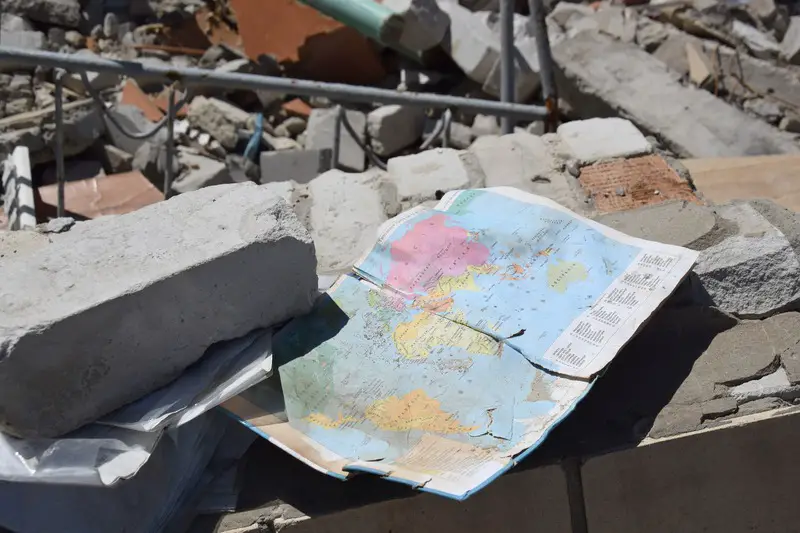
Rescue crews are still clawing through the rubble of flattened homes in a farming village outside Yemen’s capital, hunting for people no one has found yet.
Houthi health officials say airstrikes on houses in al-Shariya, a village outside Sanaa, killed 44 people, most of them women and children, on Saturday, Nov. 7, 2026, and the toll of 44 stood unchanged as of a funeral on Nov. 11, with 40 wounded.
Anees al-Asbahi, spokesperson for the Houthi-run Health Ministry, said the dead include 21 children and 10 women, and the wounded include eight children and nine women. He blamed Saudi Arabia for the strikes. The Houthi account could not be independently verified.
Al-Asbahi told Al-Masirah TV, the Houthi-run channel, that civilians remained trapped under the wreckage of the houses and that later strikes targeted the emergency workers trying to pull survivors out. In video released by the channel, hospital staff carry the limp bodies of several young children out of ambulances. The head of one girl had been cleaved open.
Officials put the toll at at least 27 dead and 36 wounded, mostly women and children, in the first count, given Nov. 7. The village is a farming community under Houthi control roughly 10 miles northeast of Sanaa, and the strikes rank among the deadliest of the latest violence in Yemen’s long-running civil war. Rescue teams are still searching for the missing, al-Asbahi said, with fears the toll will rise again.
Seven Members of One Family
Houthi rebels held a mass funeral on Nov. 11 for the 44 they say were killed near Sanaa in the Saudi airstrikes. The mourners included seven members of one family.
Hamad al-Bas, a relative of one of the victims, said, “They were women and children.” He added, “We must avenge their deaths, no matter how long it takes.”
Missiles Aimed at Riyadh’s Airport
A day before the al-Shariya strikes, on Friday, Nov. 6, an airstrike on a market in southern Yemen killed at least 30 people, according to Houthi officials. The Houthis and the Saudi-backed Yemeni military traded blame for that attack.
Houthi military spokesperson Brig. Gen. Yahya Saree said later on Nov. 7 that his fighters had hit targets in Saudi Arabia, calling it retaliation for the market bombing and for the strikes on al-Shariya. Saree announced on Nov. 11 that the Houthis fired three cruise missiles at King Khalid International Airport in Riyadh. A Saudi military spokesman had said earlier that three cruise missiles fired at the capital were intercepted and destroyed.
The Houthis also said they attacked a military camp for Saudi-backed forces outside Aden on Nov. 11. They had claimed responsibility for an earlier attack on the Saudi capital, in which missiles were shot down over Riyadh and the falling debris tore into several floors of an office tower belonging to Saudi Aramco in the financial district.
Three Houthi facilities had been destroyed, the Saudi-led coalition said on Monday, Nov. 9: a plant building parts for ballistic missiles, a chemical facility making solid rocket fuel and an electronics shop that assembled missile systems. The coalition gave no locations and no further detail.
An attack on the east-west pipeline in the Medina region that same day was reported by Saudi Arabia’s Energy Ministry. The ministry described the resulting fire as limited and quickly extinguished, said nobody was hurt and said operations were not affected, but it did not identify who was behind the attack. The Houthis, who have repeatedly targeted Saudi infrastructure, had no immediate comment on the pipeline.
The Houthi-run health ministry said an airstrike on a gas station in Sanaa on Nov. 10 killed one person and wounded three, again blaming Saudi Arabia, and that another strike targeting an oil company wounded at least six. The Associated Press could not independently verify the claims. A Saudi-led coalition spokesperson posted on X that day that a drone had been intercepted and destroyed in eastern Saudi Arabia.
Damascus and Tehran Push Back
Syrian Foreign Minister Asaad al-Shibani told a news conference in Damascus on Nov. 9 that Syria has deployed no forces to Yemen to fight the Houthis and has no immediate plan to do so. “any military operation outside our borders would certainly be announced and discussed publicly,” he said. The Associated Press has reported that Damascus is readying an initial 600 special forces troops for deployment along Saudi Arabia’s border with Yemen. Al-Shibani did not address those reports directly.
U.S. Secretary of State Marco Rubio on Sunday, Nov. 8, called Iran’s demands for ending the war “outrageous and ridiculous” and “really not realistic.” Among them, Tehran wants the U.S. to lift its blockade of Iranian ports. It is also seeking an end to sanctions, the release of frozen assets and compensation for war damage.
U.S. Defense Secretary Pete Hegseth said on Nov. 9 that the conflict was necessary because “someone had to confront the Iranian regime’s pursuit of a nuclear weapon,” and that “Iran is devastated.” Next steps are up to President Donald Trump, he said.
Esmail Baghaei, Iran’s foreign ministry spokesperson, dismissed Rubio’s characterization on Nov. 9, saying the U.S. strikes carried out during peace talks in June 2025 and February 2026 were “illogical and ridiculous,” not his country’s demands.
A Truce That Fell Apart
Yemen’s war has worsened sharply since a truce reached in 2022 collapsed over the summer, when the Houthis launched new offensives. Sanaa, the north and the west are in the hands of the Iranian-backed Houthis, while their Saudi-backed opponents are based in the south and east.
The group pushed President Abd Rabbu Mansour Hadi out of Sanaa and into exile in Riyadh, and Saudi Arabia responded by opening its air campaign against the Houthis in late March 2015. Saudi-led airstrikes on the headquarters of Yemen’s armed forces in the capital left at least 44 people dead on June 7, 2015, a week before peace talks were due to open in Geneva.