
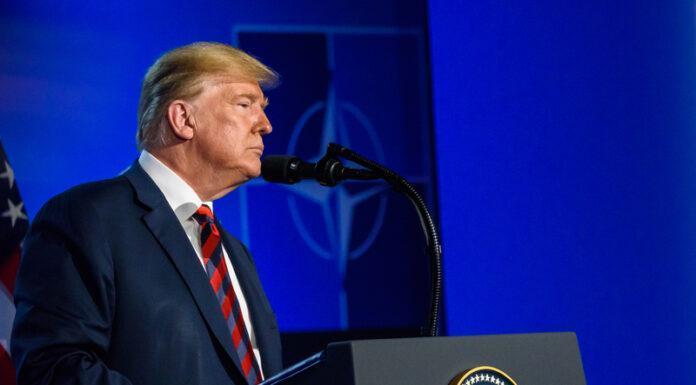
President Donald Trump brushed aside the idea that Russia might attack NATO, telling reporters in the Oval Office on August 27, 2026, that the alliance faces no such threat — a conclusion he said came out of his own dealings with Russian President Vladimir Putin, and a forecast that runs against the warnings coming from U.S. intelligence.
“I’ve had good talks with Putin. He’s not going to be attacking a NATO territory,” Trump said, when he was asked whether Putin had given him that assurance.
Had CIA Director John Ratcliffe delivered such a warning in Moscow days earlier? The president would not comment on that question, but he insisted again that Russia would not strike.
Ratcliffe had landed in the Russian capital on August 25, on a trip the administration never announced. It surfaced the same day, after a U.S. Air Force jet was spotted setting down at a Moscow airport and a diplomatic motorcade moved through the city. He was on the ground about eight hours, according to a later account, having stopped first in Latvia. As CIA director he had never been known to visit Russia before, and no agency chief had done so since then-CIA Director William Burns, who in early November 2021 warned the Kremlin against sending troops into Ukraine. The invasion came the following February, less than four months later.
What the CIA Chief Carried to Moscow
A warning against any attack on NATO member states was what Ratcliffe delivered to his Russian counterparts, CBS News reported, along with pressure on Moscow over Iran while Washington works to squeeze Tehran’s finances. He also warned that more U.S. sanctions would follow if the Strait of Hormuz does not reopen to shipping traffic. The waterway has been effectively closed since Iran’s Revolutionary Guard announced its closure on March 2; roughly five vessels a day still pass through, down almost 95 percent from pre-war levels. Kyiv, informed that a U.S. delegation was heading to Moscow, was asked to hold off on strikes for the duration of the visit, a senior Ukrainian official said.
Behind the visit sat a far bleaker picture than the president’s public assessment. Ukraine was where Russia had slipped into an increasingly weak position, U.S. intelligence officials had assessed ahead of the trip — a vulnerability that could prompt Moscow to take military action against NATO. Nothing indicated an attack was imminent, CNN reported, though a string of intelligence warnings over several weeks had flagged increased sabotage, cyber or drone operations, and even a land grab in Europe.
Cyber and hybrid operations that stop short of conventional war made up the narrower menu of provocations on alliance soil that earlier assessments had sketched as options Putin might authorize. The aim, in that reading, was less to ignite a war than to probe NATO’s cohesion and the Trump administration’s appetite for defending allies. A pattern of recent Russian actions had prompted concern, officials told CBS News: drone incursions into Romania, a Russian missile that crossed into Poland on July 30, and an uptick in alleged sabotage and cyberattacks across Europe.
Members of the alliance are expected to defend one another under Article 5 of the NATO treaty, invoked by the United States following the terrorist attacks of September 11, 2001. A limited assault within the next few years is how Putin could test the alliance, according to reporting on leaked intelligence.
The president had already moved to lower the temperature. Speaking with radio host Glenn Beck on August 26, he said the trip was “very sort of semi-routine” and brushed aside suggestions that a NATO threat or Iran sanctions were involved, steering the conversation toward ending the war in Ukraine and saying something might come of Ratcliffe’s visit.
Moscow Dismisses the Reports
Ratcliffe met Russian intelligence officials but did not see Putin, Kremlin spokesman Dmitry Peskov said at his briefing on Wednesday, August 26, adding that the contacts were at the level of the intelligence agencies and that Putin “is immediately informed of everything.” A day later, Peskov turned to the reporting itself. “A lot of such scare stories are being published right now,” he told reporters on Thursday, August 27. Those accounts bear no relation to reality, he added, and Russia is the target of an aggressive policy from European countries. As for the war, Moscow would prefer to achieve its aims peacefully, he said, but absent that option it is pressing on with what it calls its special military operation. Ukrainian calls for direct talks between Putin and Ukrainian President Volodymyr Zelenskyy have been rebuffed repeatedly by Russia, which demands instead that Kyiv withdraw from the eastern Donbas region.
Sergei Naryshkin, Russia’s foreign intelligence chief, confirmed the meeting in remarks carried by state media. “Yes, the meeting did take place, but there is nothing unusual about it,” he said, adding that the purview of the intelligence services is a rather delicate and special matter. Ratcliffe also met Alexander Bortnikov, the director of the Federal Security Service, according to later reporting.
Washington’s alarm is not shared by Europe’s spy services. European agencies see no risk of a Russian attack on European NATO countries, and that assessment has not shifted, said a senior European Union official who spoke on condition of anonymity.
The War Grinds On
Whatever the intelligence chiefs said to one another, it did not slow the fighting. Missiles and drones came down on Ukrainian cities overnight into Thursday, August 27, and explosions rolled across Kyiv through the morning as Russia pressed the assault. A massive strike on nine Ukrainian cities was how the Russian Defense Ministry described the barrage — launched after nightfall on Wednesday, August 26 — saying it hit war-related sites: industry, oil refineries, logistics hubs and port infrastructure. Three major distribution centers were struck by drones as well, destroying depots belonging to the toy retailer Budynok Ihrashok and the confectioner Roshen and damaging one run by the electronics chain Comfy.
Four and a half years into the full-scale invasion, Ukraine is still desperately short of U.S.-made Patriot interceptors capable of knocking down Russian ballistic missiles. On Friday, August 28, Zelenskyy said Ukrainian forces hit a Russian Tu-95MS missile carrier at the Engels base, an operation he credited to the Alpha unit of Ukraine’s SBU domestic security service. Farther south, Kherson regional Governor Oleksandr Prokudin urged residents to leave — especially families with children and the elderly — saying attacks on critical infrastructure are intensifying by the day.
Trump and Putin last met in Alaska on August 15, 2025, and their most recent known phone call came on July 4, 2026, a conversation of nearly 90 minutes that the Kremlin described as businesslike and constructive.
On September 2, the president told reporters at the Oval Office that he is willing to hold another summit with Putin, but only when Moscow is ready to work toward a peace deal. “He’d do it. I want it, but I want to do it when we’re ready to do a peace deal,” he said. “I want to do it when that war is ending, and I think we will.”
A report published September 3 by the outlet Ukrainian News said Trump is ready to meet Putin, but only to sign an agreement on a complete cessation of hostilities, and quoted him saying the two leaders “ought to stop that stupid war.”
Asked at the same Oval Office session about relations with the two countries, Trump said: “We want to have good relationship with Russia, Ukraine, with everybody. Be great for business.” He also said, “There’s tremendous animosity between the two presidents, tremendous animosity.”
The diplomacy has kept moving since. Speaking at the Eastern Economic Forum on September 3, Putin was asked whether a peace deal was possible. “Is there a chance? In my view, yes, there is,” he said. Ukrainian Foreign Minister Andrii Sybiha said he expected new momentum in the peace effort, and Zelenskyy said U.S. envoys Steve Witkoff and Jared Kushner were expected in Kyiv within days.
Ratcliffe ranks among the highest-ranking American officials to set foot in Russia since the invasion began in 2022, and he is the first senior Trump administration official to travel to Moscow in months.