
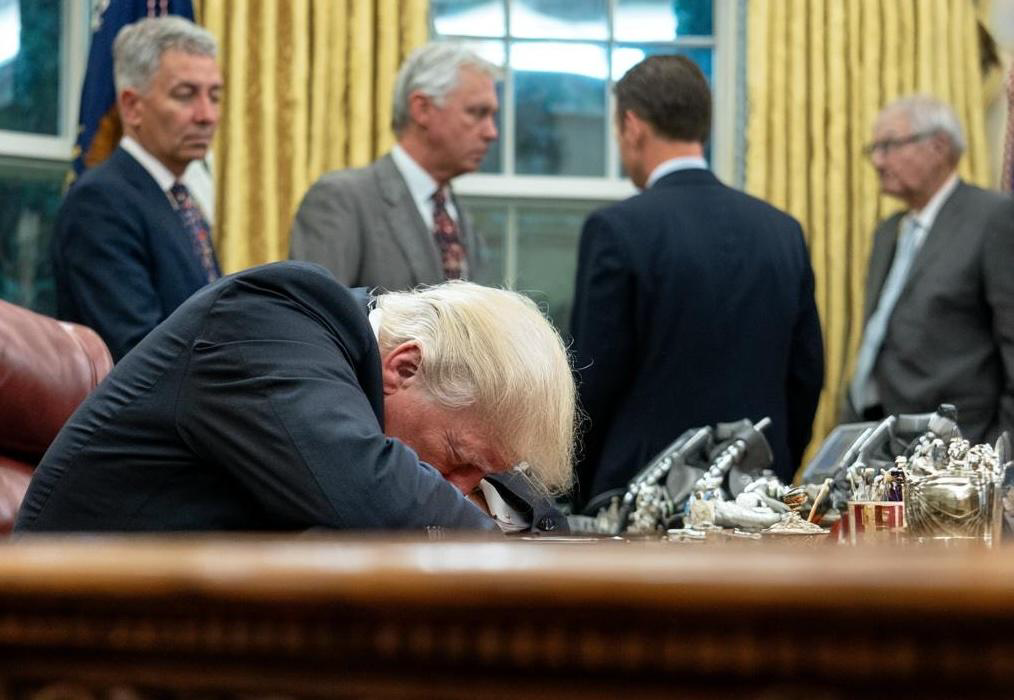
Dr. Henry Abraham, professor of psychiatry emeritus at Tufts University School of Medicine, used a radio interview Wednesday, September 2, 2026, to deliver a blunt warning: President Donald Trump could reach for a nuclear weapon during an emotional outburst. Abraham, the first signer of an April statement calling for the president’s removal from office, said his alarm has only deepened since.
Dean Obeidallah, whose show airs on SiriusXM, asked whether his conclusion about the president had shifted at all. “Yeah, if anything, it’s worse,” Abraham told the program.
A Psychiatrist’s Escalating Assessment
That answer revisited a step Abraham had taken months earlier. Thirty-six clinicians signed a statement in April publicly demanding that the president leave office, on the ground that he lacked the mental fitness the job requires. Sen. Sheldon Whitehouse entered it into the Congressional Record on April 30, on his own behalf and that of Sen. Jack Reed, and it was released publicly the following week. It did not ask the president to resign. “If we were called upon under the 25th Amendment to judge the President’s present ability to discharge the duties of his office, we would have to conclude that he lacks the capacity to do so,” the signers wrote, adding that “steps to remove him from office must be undertaken with the greatest urgency.” No cognitive condition has been diagnosed in Trump.
Scrutiny of his mental acuity has nonetheless kept building. It is driven by the occasions on which he has appeared to doze off in public, the cognitive tests he has taken and the frequency of his visits with doctors. Those tests have come back normal. Navy Capt. Sean Barbabella, the White House physician, reported that the president scored 30 out of 30 on the Montreal Cognitive Assessment after his May 26 physical — the same perfect score he posted on the same test at his physical the year before. Chronic venous insufficiency, the condition the White House disclosed in July 2025, is vascular rather than cognitive.
“It’s subtle in terms of his mental status because a lot of it is more of the same,” Abraham said. “But when you get confirmatory evidence that points in the same direction again and again, after a while you sort of know what you’re dealing with and you kind of know what needs to be done.”
The Pilot and the Surgeon
The psychiatrist borrowed two comparisons from high-stakes professions to press his point about occupational fitness. “I mean, if an airline pilot had half of the symptoms that the president of the United States has, we would not let him on an airplane; we certainly wouldn’t want to fly with him,” he said. The same logic, he argued, would apply to a surgeon about to begin a procedure.
“We wouldn’t want a neurosurgeon to walk into the operating room and operate on — this doesn’t make sense — and yet, we have a system which enfolds the president’s health in a shroud of secrecy,” he said.
Fears Over Nuclear Command
The sheer scope of presidential power, command of the U.S. military included, compounds the danger, Abraham said. “When a person has sole access to the nuclear armamentaria, it’s crazy, and this is what we’re doing,” he said.
He went on to state the risk in stark terms. “I think we’re in even more danger of Donald Trump using a nuclear weapon in a fit of pique or rage or confusion or poor impulse control than ever before,” he said. “So yes, he’s more dangerous.”
The White House rejected all of it. Spokesman Davis Ingle called Trump “the sharpest, most accessible, and energetic president in American history” and dismissed Abraham as “a Trump Deranged loser engaging in armchair diagnosis for political purposes.”
Nuclear war is also the subject that brought Abraham’s organization international recognition. The Norwegian Nobel Committee gave International Physicians for the Prevention of Nuclear War the 1985 peace prize “for spreading authoritative information and by creating awareness of the catastrophic consequences of nuclear war.” Abraham describes himself as a founding figure in the group’s American affiliate, Physicians for Social Responsibility.
Several outlets have called him a Nobel winner, and his own biography says he shared in the 1985 award as an IPPNW member. The prize was not divided: the committee gave it to the organization whole, and there are no individual 1985 peace laureates. The Congressional Record bears that out. Abraham’s entry, first among the signatories, carries no Nobel notation; two other signers are identified as prize recipients.
Within his own profession, claims of the sort Abraham is making remain contested terrain. Psychiatrists have argued for years over the American Psychiatric Association’s Goldwater Rule, adopted in 1973 and reaffirmed twice in 2017, which holds that an association member acts unethically in offering a professional opinion on a public figure without both examining that person and obtaining authorization. It binds association members; several of the April signers are psychologists and social workers, who are not subject to it. The signers cast their statement not as a clinical diagnosis but as an allegation about fitness, and its opening line calls it “not a political statement” but “a medical one.”
The midterm election cycle is heating up as the remarks arrive, and both parties are threading arguments about the president’s health, stamina and decision-making through their messaging. A video of the interview was posted to the show’s YouTube channel.