
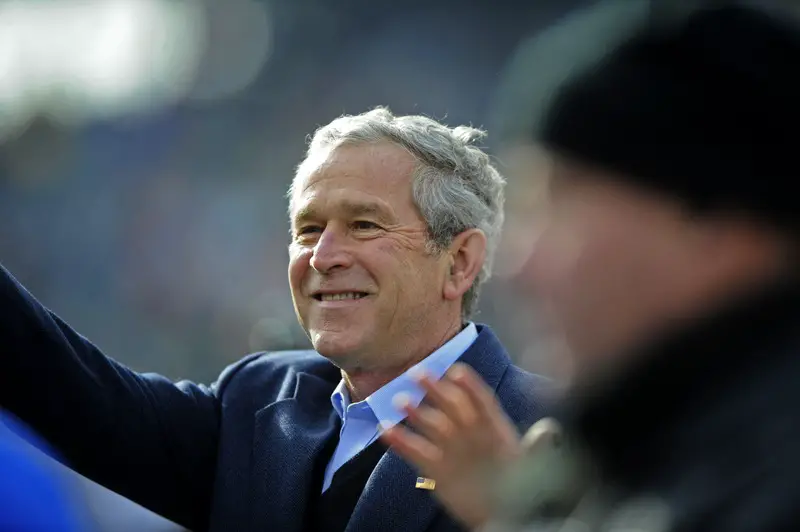
Somewhere out of public view, former President George W. Bush is keeping a canvas of President Donald Trump that no one is allowed to see, according to journalist Jacob Weisberg. Bush has “painted a really ugly picture of Trump, which he won’t show to anybody,” Weisberg said in an interview with New York magazine’s Intelligencer, reported on September 15, 2026.
Weisberg, the creator of the “Bushisms” series that cataloged Bush’s verbal stumbles in office, offered the detail to Michael Calderone, deputy editor of Intelligencer, in a conversation about his book “Profiles in Cowardice: A Study of Collaboration in the Trump Era,” which Penguin Press published September 15. Bush is one of the book’s eight subjects, and Weisberg faults the silence of the only living former Republican president, arguing he has done too little to confront Trump.
The New Yorker ran the Bush chapter as an excerpt on September 1, under the title “George W. Bush’s Code Of Silence,” ahead of the book’s publication.
Art Therapy in the Post-Presidency
Bush picked up painting once he left the White House, and Weisberg argues the brush has replaced the microphone. “He’s expressing all of his feelings through painting, this kind of art therapy,” Weisberg said. Bush paints wounded veterans and immigrants, Weisberg said — a way of engaging with politics without ever stating his views explicitly.
The concealed Trump portrait, in Weisberg’s telling, works like “The Picture of Dorian Gray”: Bush’s real views live in the artwork rather than in anything he has said aloud. Weisberg said other former presidents have spoken up occasionally about Trump’s policies, and that Bush could have and should have done the same — yet he will not say Trump’s name. Bush instead hides behind the notion that former presidents must remove themselves entirely from commenting, Weisberg said. His rapport with his Democratic counterparts, ideological differences aside, appears far warmer than anything he has with Trump.
Eight Collaborators, From McConnell to Bezos
Former Senate Majority Leader Mitch McConnell and Chief Justice John Roberts sit among the eight public figures Weisberg casts as collaborators who returned Trump to power and then entrenched him there. Another is the president of Dartmouth — “you also have a university president, the president of Dartmouth,” NPR’s Morning Edition host Steve Inskeep said to Weisberg on September 14. The subjects are leaders of law firms, universities, courts and Congress.
Convicting Trump at his second impeachment trial, held after the January 6 attack, took 67 of 100 senators — a two-thirds majority — and would have cleared the path to a separate majority vote to bar him from holding office again. Senators fell short, 57 to 43. McConnell would not reconvene the Senate before Joe Biden was sworn in, and he voted to acquit, though he called Trump “practically and morally responsible” for provoking that day’s events and pointed to the criminal justice system as the proper venue. Roberts, writing the majority opinion roughly 40 months after that, granted former presidents absolute immunity for their core constitutional powers and at least presumptive immunity for other official acts. Weisberg sharply criticizes that ruling, which unwound multiple prosecutions.
Brad Karp, then chairman of the law firm Paul Weiss, opens the book. The president targeted the firm in March 2025, and the deal Karp signed on to carried terms that included $40 million worth of pro bono representation for causes Trump backs — a bargain Weisberg says no law firm should have struck. Karp resigned the chairmanship in February 2026 and remains a partner. Megyn Kelly is profiled as well: she challenged Trump over his history of misogyny at the start of the 2016 election cycle, then endorsed him in 2024 as what she called a protector of women. Amazon founder Jeff Bezos also appears, having killed the Washington Post’s endorsement of Kamala Harris in 2024 and overhauled the paper’s Opinion section. Weisberg says his aim is to understand these choices rather than simply condemn them.
In a Morning Edition interview aired September 14, Weisberg told Inskeep the cowardice he describes is a specific kind: “I’m talking about civic cowardice.” His targets, he said, are not people who “oppose Trump’s politics” but people who failed to push back on what he called “Trump’s dictatorial behavior, his governing by emergency decree and executive order.”
Trump’s History With Unflattering Portraits
Portraits he dislikes have set Trump off before. He went after Colorado Gov. Jared Polis on Truth Social in March 2025 over a portrait of himself that hung in the state Capitol with those of other presidents, complaining that the image had been “purposefully distorted to a level that even I, perhaps, have never seen before.” The same artist, Sarah Boardman, painted former President Obama, Trump wrote, “and he looks wonderful, but the one on me is truly the worst.” He said he would rather have no picture at all, and that Polis “should be ashamed of himself.” That June, Trump’s team donated a replacement, a painting based on his official photograph.
Weisberg pressed the same case on MS NOW’s “Morning Joe” on September 14, where host Jonathan Lemire argued that Bush’s voice “would have had enough weight to maybe convince others in the Republican party.” Lemire added: “But yet Bush stayed silent.”
A Fresh Trump Jab at Bush World
Trump took another swipe at the Bush orbit on Monday, September 14, posting on Truth Social that Karl Rove, a former White House adviser to Bush, is frequently wrong and bad for the Republican Party. Rove suffers from a major case of what Trump called Trump Derangement Syndrome, the president wrote, dating the grievance to nearly a decade of beating back the causes Rove championed; he also asked why Fox News and The Wall Street Journal keep his voice alive, calling him “a stone cold loser.” Rove had prompted the post by announcing a Democratic vote of his own, one aimed at Bo French, a Republican candidate for the Texas Railroad Commission whom Rove described as a bigot. Running against French is Democrat Jon Rosenthal.
A full-time critic is not what Weisberg is asking Bush to become; nobody expects ex-presidents to respond to every development, he said. Bush’s quiet, though, belongs to a specific category of failure. “There’s sins of commission and sins of omission,” Weisberg told Calderone, assigning Bush’s reluctance to criticize Trump publicly to the second. He tied that silence to Trump having “dismantled USAID,” the agency that helped run PEPFAR, the global HIV/AIDS program Bush launched.
Not everyone is persuaded. Russ Smith of Splice Today published pushback on September 16 in a piece headlined “George W. Bush Takes a Long Breather,” calling Weisberg’s case about the 43rd president unconvincing while allowing that Weisberg, unlike many of his peers, is not overly obnoxious in print about his dislike of Trump.
As for the painting, Weisberg says, it stays where Bush has kept it: out of sight.