
Princess Astrid, Mrs. Ferner, has died peacefully at 94, the royal palace announced on Friday, September 11, 2026. Two days earlier, attendants had wheeled her into Oslo Cathedral, where the state funeral of her brother, Norway’s late King Harald V, was held.
“The Princess fell asleep today, Friday 11 September, at the age of 94,” the palace said in a statement. Her 94 years carried her from wartime exile in the United States through a marriage that cost her the style of Royal Highness and on into decades of service to the Norwegian crown.
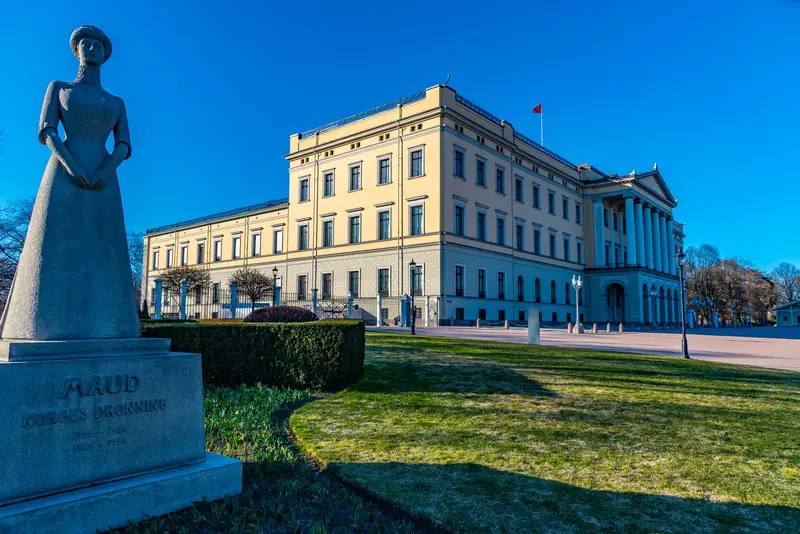
Her nephew King Haakon VIII, 53, had taken the throne from Harald on Friday, August 28. He ordered the flag above the Royal Palace balcony flown at half-mast on September 11 and again on the day of her funeral. The Royal Palace has since confirmed that the funeral will be held Wednesday, September 23, at 1:00 p.m. at Ris Church in Oslo, with the service broadcast live on Norwegian television. The church sits near Vinderen, the neighborhood where she lived with her husband, Johan Martin Ferner, and raised their five children. The princess will be buried at state expense, Prime Minister Jonas Gahr Støre said, and flags will fly at half-mast across Norway.
The service begins at 1 p.m., the same hour King Harald’s funeral service began on September 9, and King Haakon VIII is expected to lead mourners at Ris Church, which was consecrated and opened for worship in 1932 — the year Astrid was born.
King Haakon, Queen Mette-Marit, Crown Princess Ingrid and Queen Sonja will all attend, the Royal Palace has confirmed, along with Astrid’s children and other relatives. That group could include Prince Sverre Magnus, the king’s son, who does not hold formal membership in the Royal House.
King Haakon Remembers His Aunt
“Throughout her long life, Princess Astrid represented the Royal House in a warm and dutiful manner,” King Haakon said in his tribute. She had stepped into the role of first lady at just 22, he said, after the death of his grandmother, Crown Princess Märtha.
His aunt was “particularly committed to caring for and including the most vulnerable members of society,” the king said, and she carried out her duties with “loyalty, dedication and an infectious sense of humor.” He remembered a woman “never afraid to speak her mind,” a key support to Harald and to the wider family, and someone from whom relatives had learned a great deal.
Her five children — Cathrine, Benedikte, Alexander, Elisabeth and Carl-Christian Ferner — said in a joint statement: “In our grief, we stand together with gratitude. Thank you for all the wonderful memories. You will forever hold a great place in our hearts.”
At Her Brother’s Bedside
Astrid’s health had been failing for months, and doctors treated her in hospital for pneumonia in March. Her brother still drew her out. A hospital admitted Harald, Europe’s oldest living monarch, on August 17, and he was treated there for a bacterial infection in his blood. Photographers caught Astrid leaving the National Hospital in Oslo on August 27 after several hours at his bedside; the next day he died at 89, after more than 35 years on the throne.
Two photographs went out from the palace in the days before her own death. One showed the princess alone at her brother’s coffin in the Palace Chapel; the other caught her at a palace window, gazing down on the flowers mourners had laid in Palace Square. Her last public appearance came at the funeral on Wednesday, September 9. National mourning had run 13 days by then, and thousands of people packed the procession route that led from the Royal Palace to Oslo Cathedral. Denmark, the Netherlands, Sweden and Spain all sent their kings, and the mourners also included German President Frank-Walter Steinmeier, Ukrainian President Volodymyr Zelenskyy and Britain’s Prince William. Allison Hooker, the under secretary of state for political affairs, represented the United States.
Exile in Wartime and a Lifetime of Duty
Astrid Maud Ingeborg was born on February 12, 1932, at Villa Solbakken, one of the royal residences in Oslo, the second daughter of the future King Olav V and Crown Princess Märtha of Sweden. One of her godparents gave her her name — her aunt, Queen Astrid of Belgium. She was a great-granddaughter of King Edward VII and a second cousin of Queen Elizabeth II, and at birth she stood 18th in line to the British throne.
Germany invaded Norway in April 1940, when she was eight. Her mother, her sister Ragnhild and her brother Harald fled with her, first to neutral Sweden and then to the United States; the party reached New York that August, and she went to school in Washington, D.C. England sheltered her father for the war years, and he spent them at the side of King Haakon VII, acting as a military commander and a counselor to Norway’s exiled government. Home again in 1945, Astrid enrolled at Nissen, a girls’ school in Oslo. The chapel of the Royal Palace was where she was confirmed on May 9, 1948, and Oxford took her for two years of study in the early 1950s.
Cancer killed her mother in 1954, at 53. Olav was left a widower and never remarried, and Ragnhild had settled in Brazil after her 1953 marriage to her bodyguard, Erling Lorentzen, so the duties of first lady fell to Astrid, then 22. For 14 years she accompanied her father to receptions, official functions and state visits, a run that ended when Harald married Sonja Haraldsen in 1968. A memorial fund established in her mother’s name, which supports social and humanitarian projects, had her as chair of its board. Charities working with women, and with young people who have dyslexia — a condition she had herself — also counted her as a patron. In 2002, in recognition of her decades of work on behalf of the crown, Norway’s government granted her an honorary pension.
Late in life a rescue chihuahua named Wilma was frequently at her side. She adopted the dog in 2022 after the loss of an earlier rescue dog named Tarzan, and Wilma featured in her biography on the royal website: “Princess Astrid is rarely seen without her dog, Wilma. Dogs have been a cherished part of her life from an early age — she received her first from her parents on her second birthday.” As of September 17, the royal house had not shared any plan for the dog’s care.
The Marriage That Cost Her a Title
A businessman and Olympic sailor, Johan Martin Ferner had taken silver in the sport in Helsinki in 1952, and she fell in love with him in the late 1950s. The two met when she took him on as crew for a yacht race. A department store in Oslo belonged to his father, and conservative figures in the Norwegian establishment objected to a commoner; because he was also a divorcé, the church objected too. Unless her father consented, Astrid was said to have threatened to go on a hunger strike and to abandon her royal duties.
Olav relented, though the bishop of Oslo refused to officiate, leaving him to ask the retired bishop of Nidaros instead. They married at Asker Church on January 12, 1961. The match cost Astrid the style of Royal Highness and her yearly allowance, and she went by Princess Astrid, Mrs. Ferner from then on. Well into her nineties she was still representing the monarchy and its charities. She had her five children between 1962 and 1972. Johan Ferner died in 2015.
Harald’s death left Astrid the only living child of King Olav V and Crown Princess Märtha; her elder sister, Princess Ragnhild, Mrs Lorentzen, died in 2012. She is survived by her five children and seven grandchildren. At her death Astrid was the eldest surviving descendant of Queen Victoria, a distinction that now passes to her third cousin, Anne Abel Smith, 94, a granddaughter of Princess Alice, Countess of Athlone.