
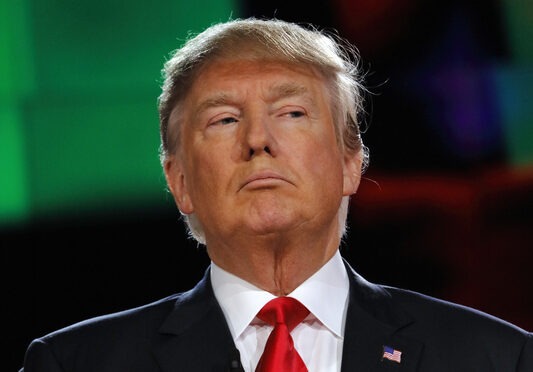
A national anthem controversy erupted at Madison Square Garden on June 8, 2026, when President Donald Trump stood motionless with his hands at his sides while Broadway star Avery Wilson performed “The Star-Spangled Banner” before Game 3 of the NBA Finals between the New York Knicks and the San Antonio Spurs. Trump, the first sitting president to attend an NBA Finals game, was greeted with boos from the crowd. The Knicks lost 115-111, snapping a 13-game winning streak — a result some fans were quick to blame on Trump’s presence.
Trump’s arrival with an entourage that included his 19-year-old granddaughter Kai Trump and several members of his cabinet caused major headaches for fans trying to enter the arena, with security measures snarling traffic outside one of the most famous venues in sports. The president — who officially changed his primary residence from New York City to Palm Beach in 2019 — received a largely hostile reception from many fans in attendance.
A Jumbotron Moment Gone Wrong
Trump first appeared on Madison Square Garden’s Jumbotron after the anthem had already begun. As his image flashed across the giant screen, the arena erupted into boos.
At first, Trump stared straight ahead without moving, his hands at his sides, as those around him, including Kai Trump and several cabinet officials, placed their right hands over their hearts. By the time Wilson had finished the first stanza, Trump was still standing motionless. It wasn’t until the camera panned to him that the president lifted his hand in a military salute, followed by a fist pump.
What the Flag Code Actually Says
According to the U.S. Flag Code, individuals should place their right hand over the heart while the national anthem is being performed. Federal law, specifically 36 U.S. Code § 301, states that “individuals in uniform should give the military salute at the first note of the anthem and maintain that position until the last note.”
The code goes on to specify that “all other persons present should face the flag and stand at attention with their right hand over the heart, and men not in uniform, if applicable, should remove their headdress with their right hand and hold it at the left shoulder, the hand being over the heart.”
The Flag Code carries no enforcement mechanism and no penalty for violations. But the optics matter — particularly for a president who has spent much of his political career criticizing NFL players who knelt during the anthem and casting himself as the foremost defender of patriotic ritual.
Trump has never served in the armed forces. He avoided being drafted during the Vietnam War five times, receiving four education deferments and one medical deferment for bone spurs in 1968. Yet he has made a habit of saluting during the anthem — including at the Army-Navy football game, during his inauguration proceedings in January 2025, and at a church service at Washington National Cathedral.
A Pattern of Hostile Welcomes
The reaction at Madison Square Garden was not the first time Trump has been jeered at a New York sporting event. He drew a mixed reaction of boos and cheers at a New York Yankees game at Yankee Stadium in September 2025, where he also opted for a salute rather than the hand-over-heart gesture.
And anthem trouble has dogged him for years. On Jan. 8, 2018, while attending the college football championship game in Atlanta, Georgia, between the University of Alabama and the University of Georgia, Trump appeared to mouth the wrong words to the anthem. Footage from that night showed him mouthing some lyrics while occasionally pausing and missing others entirely. He clearly mouthed “bright stars” and finished with a flourish, smiling and singing “the land of the free and the home of the brave” — but other lines were not sung at all. That appearance was greeted with a mixed reaction of cheers and boos.
Trump’s anthem habits have invited comparisons to other presidents. Former President Barack Obama famously neglected to put his hand over his heart during the 2008 election campaign, later explaining that his grandfather had taught him the hand-over-heart gesture applied to the Pledge of Allegiance, not the national anthem — and that one should sing during the anthem instead.
Trump has been pictured singing the anthem in the past and has been vocal in his support of respecting the anthem and the flag — making the moment at Madison Square Garden all the more striking. Asked by reporters what he made of the reception, Trump was unbothered. “I thought it was amazing, actually,” he said. “It was, I think, mostly cheers. It was loud, and it was very enthusiastic.” Whether anyone in his orbit attempts to brief him on the difference between a salute and a hand over the heart before the next high-profile sporting event remains, like the anthem itself, an open question.
The moment took on a new dimension when Kai Trump posted a video on Instagram thanking an app called 15 Seconds of Fame for capturing the moment. Viewers noted the audio appeared to replace the arena’s boos with generic cheers, with the anthem itself absent. The app, which uses facial recognition to create personalized game-day clips, subsequently issued a statement to Page Six directly exonerating Kai. “The video shared by Kai Trump on Instagram was exactly the clip delivered by 15 Seconds of Fame (15SOF) to her account on our app and at no time did she request that any audio be altered, enhanced, replaced, or otherwise manipulated,” the company said, attributing the audio swap to “broadcast, licensing, and contractual restrictions” that prevent the app from distributing original event audio.