
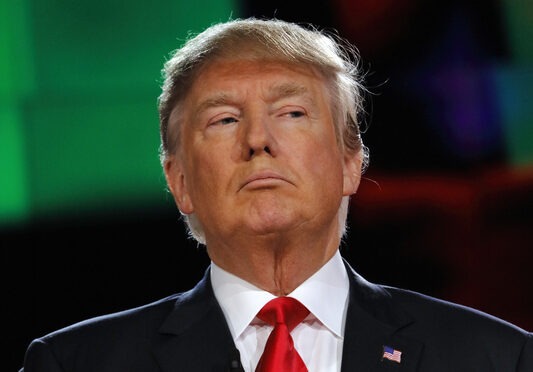
President Donald Trump stated in a Fox Business interview broadcast April 15, 2026, that the conflict with Iran is “very close to over,” despite ongoing U.S. naval enforcement of a blockade at Iranian ports and House Republicans blocking another Democratic attempt to restrict the president’s military powers.
During a recorded conversation with Maria Bartiromo on “Mornings with Maria,” Trump indicated that military operations had achieved significant success. “We’ve beaten them militarily, totally,” Trump stated, noting that if he “pulled up stakes right now, it would take them 20 years to rebuild that country.” His remarks coincided with the U.S. Central Command’s announcement that 31 vessels have turned back rather than attempt to breach the U.S. blockade—an initiative projected to inflict $435 million in daily economic losses on Iran.
The president’s upbeat evaluation stood in contrast to conditions in the field. U.S. Central Command verified April 16 that the blockade was “fully operational” within 36 hours following Trump’s directive, with over 10,000 U.S. personnel, at least a dozen naval vessels, and more than 100 aircraft implementing the embargo on Iranian ports. Admiral Brad Cooper stated that U.S. forces had “completely halted economic trade going into and out of Iran by sea.” On April 23, Trump ordered the U.S. Navy to “shoot and kill” any Iranian boats laying mines in the strait, and tripled the pace of U.S. mine-clearing operations in the waterway.
In the House, lawmakers voted down a Democratic war powers measure by an exceptionally narrow 213 to 214 margin on Thursday, April 16, marking the third unsuccessful bid to limit Trump’s control over the Iran situation. Rep. Jared Golden of Maine, a moderate Democrat leaving office after this term, sided with Republicans in voting against it, while libertarian-oriented Rep. Thomas Massie of Kentucky crossed party lines to support Democrats.
Rep. Mike Lawler, R-N.Y., has been among the Republicans defending the administration’s approach, facing contentious constituent meetings in his suburban competitive district where residents have pressed him to justify his votes against limiting the president’s war authority.
White House Deputy Chief of Staff for Policy Stephen Miller provided a forceful endorsement of the blockade during a “Hannity” appearance, characterizing the U.S. action as “resetting the entire global order.” Miller told Fox News host Sean Hannity that “this embargo is squeezing the economic life out of the Iranian regime, and the United States has the capacity to continue this indefinitely if Iran chooses the wrong path.”
Broader implications extend beyond the region as Trump readies for a rescheduled meeting with Chinese President Xi Jinping, rescheduled for mid-May in Beijing, postponed from its initial late March timeframe due to the Iran situation. Trump announced via Truth Social that Xi would extend him a “big, fat, hug” at their gathering, highlighting China’s reported commitment to withhold military support to Iran in return for the U.S. “permanently reopening” the Strait of Hormuz.
The conflict has taken a high human cost. Thirteen U.S. military personnel have died, and roughly 381 have sustained injuries since operations commenced on February 28. Regional fatalities have reached approximately 6,000 individuals, reports indicate, approximately 3,400 in Iran, with more than 2,200 in Lebanon. A 10-day truce between Israel and the Lebanese authorities commenced, with displaced persons relocating toward southern Lebanon, though ambiguity persists regarding Hezbollah’s position.
Throughout Iran, the situation has deteriorated as a result of sustained air strikes and the expanding blockade. Price inflation has accelerated dramatically, with basic food costs climbing as high as seven times their previous levels in recent weeks. The rial has experienced substantial depreciation, approaching 1.6 million per dollar in unregulated markets. Specialists caution that without revenue from exports, Iran’s petroleum reserves could reach capacity within 13 days, potentially forcing oil production shutdowns and risking irreversible harm to extraction infrastructure.
On April 22, Trump extended the ceasefire indefinitely via Truth Social, saying military attacks would be held off until Iranian leaders “can come up with a unified proposal” — a move made at the request of Pakistani mediators. The naval blockade, however, remains fully in place. Iranian Foreign Minister Abbas Araghchi called the blockade an “act of war” and a ceasefire violation. Hours after the extension was announced, Iran’s Revolutionary Guard attacked three commercial ships in the Strait of Hormuz and seized two of them — MSC Francesca and Epaminondas — saying the U.S. blockade was a “main obstacle” to new peace talks. A second round of U.S.-Iran negotiations in Islamabad, to be led again by Vice President Vance, remained in limbo as of April 24, with Tehran yet to confirm its participation.
Vice President JD Vance, who led the American negotiating team at unsuccessful talks in Islamabad earlier this month, indicated Trump is pursuing a broader deal with Iran. Vance said the president “would be very happy if Iran was treated like a normal country, if it had a normal economy, if its people were able to prosper and thrive,” but added that Iran must also abandon its nuclear weapons pursuit and state sponsorship of terrorism.
Presently, the American military position remains confrontational. Secretary of Defense Pete Hegseth has cautioned Iranian authorities that military strikes will resume absent a settlement. Trump has regularly declared that should Iran opt against dismantling its nuclear program, “I don’t know how much longer they can survive.”
Trump’s claim that the hostilities are “very close to over” exists awkwardly alongside the 31 turned-back ships, the 13 American service members lost, and the murky outlook moving forward. Regardless of whether his remarks represent assured calculation or optimistic projection, observers worldwide await confirmation of whether deeds align with statements before the ceasefire expires.