
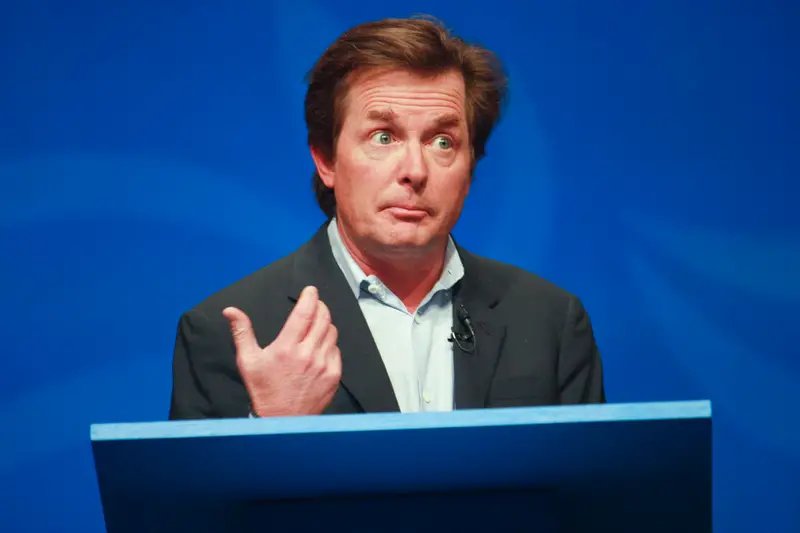
On April 8, a bizarre mistake by CNN sent shockwaves across social media. The network published a appeared to be an obituary video titled “Remembering the life of actor Michael J. Fox.”
The error sparked immediate panic among fans who feared the beloved “Back to the Future” star had died. The tribute video appeared on CNN’s digital platforms before being quickly removed.
The 64-year-old actor posted a photo on April 10, showing himself alongside boxing legend Freddie Roach, both men smiling as they bumped fists. The caption was blunt: “**** Parkinson’s.”
True to form, Fox addressed the incident with humor. On Threads, he posted a multiple-choice question asking followers how they would react to seeing their own death reported on television. Options ranged from switching to MSNBC to pouring scalding water on their lap to check if they’re still alive. He closed the post with reassurance for concerned fans.
CNN issued an apology to outlets, stating: “The package was published in error. We have removed it from our platforms and send our apologies to Michael J. Fox and his family.”
The post carried weight far beyond its brevity. Both men have spent decades battling Parkinson’s disease while refusing to let it define them. Roach, now 66, was diagnosed in his mid-twenties and went on to train some of boxing’s greatest champions at the Wild Card Boxing Club in Los Angeles, including Manny Pacquiao, Miguel Cotto, and Amir Khan. His professional record includes roughly 150 amateur fights and 53 professional bouts before he transitioned to training at age 26, the same age his symptoms began.
The Hall of Fame trainer didn’t hold back in the comments section, echoing Fox’s sentiment: “I’m with @realmikejfox – **** Parkinson’s.”
The accidental publication underscores the risks of premature obituary releases in the digital era. News organizations routinely prepare tributes for public figures in advance, but such mistakes can cause immediate distress. This wasn’t the first time Fox has faced false death reports—a similar hoax circulated in 2018 claiming he had died of pneumonia.
Fox received his Parkinson’s diagnosis in 1991 at age 29, a crushing blow for the actor who had achieved international fame through the “Back to the Future” trilogy and the sitcom “Family Ties.” He kept the diagnosis private for seven years before going public in 1998, transforming his personal struggle into a mission to advance research.
In 2000, he founded the Michael J. Fox Foundation for Parkinson’s Research, which has funded more than $2 billion in research, surpassing even U.S. government funding for the disease. On April 10, the foundation announced that its CEO and co-founder, Deborah W. Brooks, and Patient Council member Israel Robledo had been appointed to the inaugural Federal Advisory Council on Parkinson’s Research, Care and Services. The council was created to guide the National Parkinson’s Project, a federal initiative authorized by Congress in 2024 aimed at accelerating research, treatments, and ultimately a cure. He continued acting for more than two decades after his public disclosure, maintaining regular television appearances with acclaimed guest roles on “The Good Wife” and “Shrinking.” In 2020, as symptoms advanced, he stepped back from full-time acting, though he has continued making periodic appearances.
Fans responded with overwhelming support. One commenter wrote that it’s “been amazing to watch you punch the **** out of Parkinson’s for so many years.” Another shared a personal connection: “My father passed from Parkinsons/Lewy Body almost 3 years ago. I am forever rooting for you.”
The image of Fox and Roach together represents more than friendship—it’s a visual statement of two fighters refusing to surrender. Roach built his reputation training more than 27 world champions despite his own health challenges. In June 2023, he married his longtime partner, Marie Spivey, inside the Wild Card boxing ring—a ceremony as unconventional and determined as the man himself.
In fall 2025, Fox opened up to The Sunday Times about his mortality and the uncertain trajectory of his condition. He explained that Parkinson’s differs greatly from many other serious illnesses because it lacks a predictable course. Unlike diseases such as prostate cancer, there is no defined sequence of stages or timeline that patients can expect. He described Parkinson’s as being “much more mysterious and enigmatic” than other health conditions.
While promoting his new memoir, “Future Boy,” Fox shared his hope for a peaceful passing when the time arrives. He told the newspaper that his ideal scenario would be to simply not wake up one day, calling that idea really cool. Fox also made clear that he does not want a dramatic or traumatic ending, saying he would prefer not to fall over furniture or suffer a fatal head injury.
He also reflected on how unusual his experience is, noting that very few people have lived with Parkinson’s disease for as long as he has. The progressive brain disorder leads to symptoms such as tremors, slowed movement, and increasing mobility difficulties that intensify over time.
To cope with the advancement of the disease, the actor has made major adjustments to his daily life. He told The Times that he rarely walks anymore because of safety risks. Although he is still physically capable of walking, Fox admitted that his gait is awkward and potentially dangerous. He said he has learned to fold these limitations into his routine, joking lightly about integrating that reality into his life.
The boxing metaphor seems particularly apt for both men’s approaches to their diagnoses. While Parkinson’s is a progressive disease with no cure, both Fox and Roach have demonstrated a fighter’s mentality in managing their conditions and maintaining active, productive lives.
Fox’s post serves as a defiant message against the disease that has shaped much of his adult life and a rallying cry for the millions of people worldwide living with Parkinson’s. The image of two warriors—one from entertainment, one from sports—standing together in defiance resonated across social media platforms.