
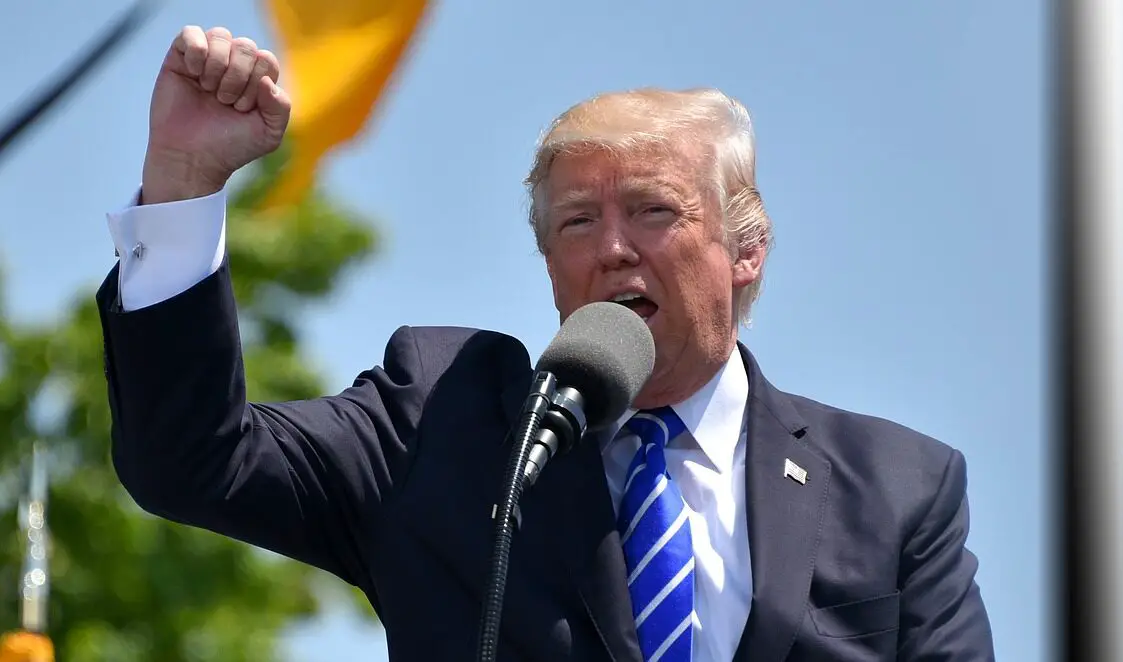
Many will recall that President Donald Trump signed a broad executive order aimed at Iran in February 2025, warning then that he had left instructions for the country to be “obliterated” if he were ever assassinated. “I’ve left instructions. If they do it, they get obliterated; there won’t be anything left,” Trump declared at the signing ceremony.
More than a year later, with the United States engaged in open conflict with Iran, that warning has been met with a reciprocal threat — and Tehran’s long-running effort to target Trump has grown more urgent.
On March 10, 2026, as U.S. and Israeli strikes on Iran escalated, Iran’s top national security official issued what many analysts called the most direct public threat against a sitting U.S. president in recent memory. Ali Larijani, head of Iran’s Supreme National Security Council and a leading figure in the clerical regime, threatened President Trump with assassination in a post on X, writing: “The freedom-loving nation of Iran is not afraid of your hollow threats. Even those who were mightier than you have failed to destroy the Iranian nation. Watch yourself — or you’ll be eliminated.”
The warning followed a Truth Social post from Trump saying Iran would be struck “TWENTY TIMES HARDER” if it halted oil transit through the Strait of Hormuz. Larijani’s statement, issued by the Supreme National Security Council of Iran, also referenced the recent death of Supreme Leader Ali Khamenei.
Trump downplayed the threat in an interview with CBS News, saying he “couldn’t care less.”
After Khamenei’s killing on February 28 — the opening day of the joint U.S.-Israeli attack on Iran — Larijani had also vowed on television to hold Trump personally responsible for the supreme leader’s death.
While Iran issued fresh threats, U.S. forces were simultaneously dismantling the networks Iran had used to target Trump. Defense Secretary Pete Hegseth confirmed the leader of the Iranian unit behind a prior assassination attempt on Trump was killed in U.S. military strikes, saying, “Iran tried to kill President Trump, and President Trump got the last laugh.”
Trump spoke about the killing on March 2: “I got him before he got me. They tried twice. Well, I got him first,” connecting the alleged assassination attempts to the wider U.S. strikes on Iranian leadership.
Hegseth did not identify the person, but Israeli reporter Amit Segal named him on X as Rahman Mokadam, who is reported to lead the IRGC’s special operations division.
Larijani’s public threat came days after a major legal development in the U.S. Asif Merchant, a Pakistani national allegedly trained by Iran’s Islamic Revolutionary Guard Corps, was convicted in a conspiracy to assassinate Trump. U.S. national security officials had warned the Trump campaign that Iran was actively targeting him and that multiple suspected operatives were believed to be inside the United States.
Attorney General Pamela Bondi said of the verdict: “This man landed on American soil hoping to kill President Trump — instead, he was met with the might of American law enforcement.” FBI Director Kash Patel added that the case was not Iran’s first attempt to harm Americans on U.S. soil.
Court records highlighted the reach of Iran’s operations. An undercover video shown in a Brooklyn courtroom captured an alleged Iran-linked operative explaining the 2024 plot in detail, placing a vape pen on a napkin as a stand-in for his target and asking: “This is the target. How will it die?”
The threats date back to January 2020, when Trump ordered the drone strike in Baghdad that killed Iranian General Qasem Soleimani, commander of the IRGC’s Quds Force. Iranian officials have repeatedly vowed revenge for Soleimani’s death and named Trump and former Secretary of State Mike Pompeo as targets.
Trump’s security detail has taken those threats seriously for years. After a second assassination attempt on Trump in Florida in 2024 — not linked to Iran — his protection team was so concerned about an Iran-related risk that he traveled to an event aboard a decoy plane owned by Steve Witkoff.
The Justice Department has documented several alleged Iranian plots against Trump and other former administration officials over time, including a 2022 plan targeting former National Security Adviser John Bolton.
Trump’s earlier “obliterate” warning — issued as a deterrent more than a year earlier — now reads less hypothetical and more like a policy already underway.