
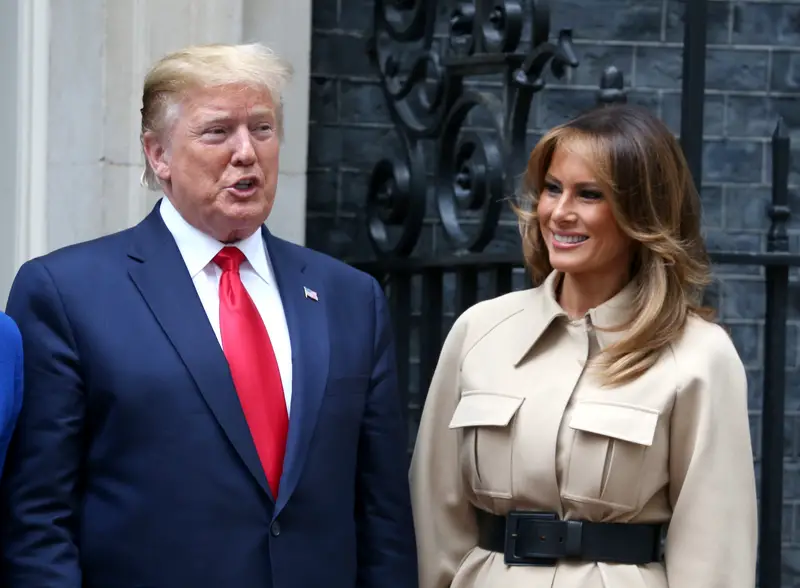
President Donald Trump privately informed First Lady Melania Trump that his government’s aggressive immigration measures have turned into “election poison.” This startling acknowledgment comes as the president encounters mounting pressure to reform Immigration and Customs Enforcement (ICE) following multiple prominent raids that triggered nationwide fury.
The remark followed violent incidents in Los Angeles when ICE raids sparked confrontations with police, prompting Trump to dispatch approximately 700 U.S. Marines from the Marine Corps Air Ground Combat Center Twentynine Palms to provide support. These military personnel reinforced National Guard troops already safeguarding federal personnel and properties throughout the greater Los Angeles region.
During the past year, interior immigration enforcement underwent a dramatic transformation under Gregory Bovino, the Border Patrol commander-at-large, a position eliminated in January 2026, who emerged as the visible representative of the administration’s domestic enforcement initiative. Congress authorized approximately $178 billion for the Department of Homeland Security (DHS) via reconciliation, the most substantial supplemental DHS funding measure in history, enabling broadened enforcement operations across the nation.
The cost in human lives has been high. The killings of Renee Good and Alex Pretti by Immigration and Customs Enforcement (ICE) and Customs and Border Protection (CBP) officers amplified condemnation that the administration had deserted its declared emphasis on immigrants with criminal histories. Both 37-year-old U.S. citizens were fatally shot in Minneapolis during Operation Metro Surge in January 2026.
“Immigrants, refugees, asylum seekers, and their allies are no longer safe,” said HIAS staff in a statement after the shootings.
On March 26, U.S. District Judge Nancy E. Brasel issued a 69-page order restricting ICE from transferring detainees out of Minnesota and requiring that they be given meaningful access to legal counsel. “Due process is not a game of keep-away,” the judge wrote. The ruling built on a temporary restraining order she had issued in February following Operation Metro Surge.
The administration implemented an extensive reorganization of ICE, substituting more than a dozen senior officials in multiple cities with leaders from CBP. Jason Houser, ICE chief of staff from 2021 to 2023, characterized the restructuring as motivated by politics instead of operational law enforcement requirements.
“What’s unfolding under Bovino isn’t law enforcement. It’s political stagecraft directed from Washington, not the field,” Houser wrote in his analysis of the enforcement changes.
White House Deputy Chief of Staff Stephen Miller has assumed a significant role in formulating immigration policy. He is working in close coordination with the new Homeland Security Secretary Markwayne Mullin, confirmed by the Senate on March 22 to replace former Homeland Security Secretary Kristi Noem, and “border czar” Tom Homan. Miller conducts daily 10 a.m. calls requiring agency reports and applies pressure to officials who underperform. Collectively, they pushed forward plans to station ICE agents at airport security checkpoints during the ongoing partial DHS shutdown and to establish temporary detention facilities to handle thousands of migrants.
The enforcement operation has extended to virtually every part of the nation. More than 400,000 individuals have been processed through an expanded immigration detention infrastructure, enlarged to accommodate the administration’s objective of one million removals annually.
The possible magnitude of deportations is massive. Over 16.7 million people reside with at least one undocumented family member, with approximately six million of those being children under 18. Undocumented adults constitute nearly five percent of the labor force. The American Civil Liberties Union (ACLU) has advocated for reducing the scope of the immigration detention system by at least 75 percent.
In Los Angeles, where many conflicts took place, municipal officials have openly clashed with federal authorities regarding enforcement methods. California Gov. Gavin Newsom condemned the troop deployment as a “serious breach of state sovereignty” and has initiated multiple lawsuits against the administration.
In San Antonio, Texas, community leaders gathered at City Hall on Feb. 20, 2026, to demonstrate against the administration’s policies. Comparable protests have occurred in cities throughout the country, from Atlanta to New York City, as information about enforcement operations circulated.
Community organizers and advocacy groups like HIAS have organized throughout the nation to assist immigrant families confronting detention or deportation. In Minneapolis, thousands participated in candlelight vigils following the Good and Pretti shootings.
Naureen Shah, ACLU director of policy and government affairs for immigration, characterized sending ICE agents to airports as an unprecedented escalation. ICE officers spread out at 14 airports, including JFK, Atlanta, New Orleans, and Phoenix, beginning March 23, but the deployment had a limited practical effect, with passengers reporting wait times as long as five hours in Houston. Trump directed the deployment during a partial DHS shutdown that has left Transportation Security Administration (TSA) employees unpaid since February 14, causing widespread absences and lengthy security lines. Trump acknowledged that the agents might make immigration arrests at airports, informing reporters that the airports were “very fertile territory.”
The airport deployments heightened pressure on Congress to conclude the partial DHS shutdown. On March 27, Trump signed an executive order directing DHS to pay TSA officers, with the agency saying checks would begin arriving as early as March 30. The Senate voted in the early hours of March 27 to pass a bill funding all of DHS except ICE and parts of CBP, with Democrats hailing it as a win despite securing none of their demanded ICE reforms. The House then rejected the Senate bill 213–203, passing its own 60-day measure fully funding DHS, including ICE, without any Democratic reforms attached. With both chambers departing for a two-week recess, the shutdown remained unresolved.
Vice President JD Vance has mostly remained silent publicly regarding the controversy, though sources say he has privately expressed concerns about the political consequences. The administration’s approval ratings on immigration have declined dramatically since early 2026, with polling indicating growing anxiety, even among Republican voters, about the tactics in use.
With Trump approaching his 80th birthday in June, he confronts a critical decision about whether to continue the current enforcement strategy or alter course. His comment to Melania suggests he recognizes the political risk, but abandoning the hardline approach that has defined his presidency would necessitate substantial policy modifications.
The outcome matters deeply for millions of immigrant families.