
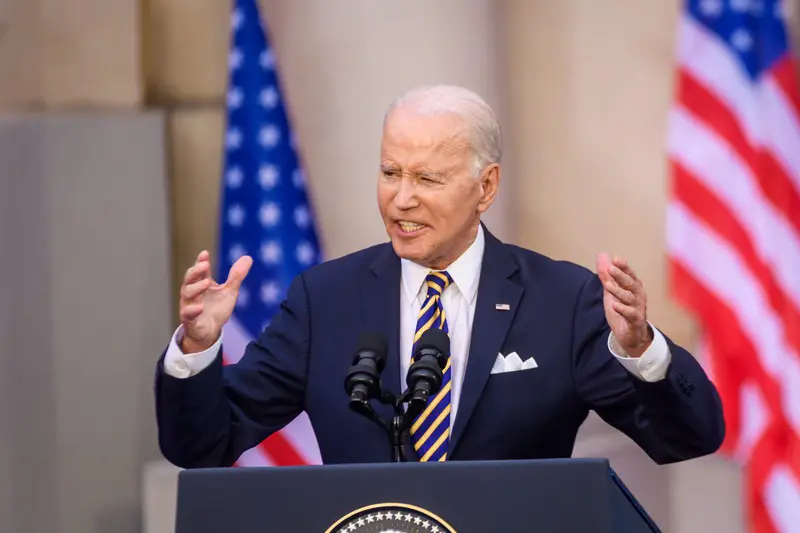
Former President Joe Biden returned to South Carolina on Feb. 27, 2026, delivering a forceful speech at the Columbia Museum of Art that strongly criticized President Donald Trump’s leadership and policies while rallying Democrats ahead of the 2026 midterm elections.
Biden, 83, making his first public comments since leaving office in January 2025, spoke for roughly 20 minutes at a South Carolina Democratic Party fundraising event. The gathering marked the sixth anniversary of his pivotal 2020 primary victory in the state—a win that revived his presidential campaign and helped send him to the White House.
Biden quickly moved to attack Trump’s recent State of the Union address, which ran a record 1 hour and 47 minutes on Feb. 24. Joking about the lengthy speech to a laughing audience, Biden quipped: “Is he still talking?”
The tone soon shifted as Biden spoke about what he called the “dark days” facing the United States. He criticized Trump for failing to acknowledge the deaths of two U.S. citizens, Renee Good and Alex Pretti, who were fatally shot by immigration agents in Minnesota during the State of the Union speech.
“He doesn’t mention Renee Good, Alex Pretti, who were killed in Minnesota by ICE—offer even a word of solace to their families,” Biden said. He also accused Trump of attempting to suppress voter turnout ahead of the midterms, arguing that Trump knows he cannot win legitimately and will work to limit voting access instead.
Rep. Jim Clyburn, the South Carolina Democrat whose backing was crucial to Biden’s resurgence in the 2020 primary, introduced him. The two exchanged a warm embrace before Biden addressed the crowd at the Columbia Museum of Art.
Biden defended his administration, stressing economic growth and falling crime rates during his presidency. He pointed to the creation of 2.2 million jobs in 2024, his final year in office, comparing it to what he said were only 185,000 jobs created in Trump’s first year back in office.
On immigration—central to Trump’s return to the presidency—Biden pushed back by stating that border crossings were lower when he left office than when he took over in 2021, despite historic global migration driven by COVID-19.
The event marked a significant public appearance for Biden, who has maintained a relatively low profile since leaving Washington. He revealed in May that he had been diagnosed with stage 4 prostate cancer that had metastasized to his bones. In October, his office announced he was undergoing radiation and hormone therapy as part of a new phase of treatment.
Biden’s trip to South Carolina also generated attention. He took a commercial flight from Reagan National Airport, where fog delays forced him to wait alongside other travelers. Supporters welcomed him warmly, though one woman confronted him about the conflict in Gaza. He later vacationed with family on Kiawah Island near Charleston.
Behind the scenes, Biden has remained active in Democratic politics. He has spoken with California Gov. Gavin Newsom by phone, met with Rep. Alexandria Ocasio-Cortez for over an hour in his Washington office, and called Virginia Gov. Abigail Spanberger before her response to Trump’s State of the Union address.
An NBC News poll found that 60 percent of respondents somewhat or strongly disapproved of Trump’s management of border security and immigration—a vulnerability Biden aimed to underscore in his comments.
South Carolina holds deep personal significance for Biden beyond his 2020 victory. The state has felt like a second home after his native Delaware, where he frequently vacationed with family. As a senator, he built close relationships with longtime South Carolina senators, Republican Strom Thurmond and Democrat Fritz Hollings, and delivered eulogies for both men.
During his presidency, Biden elevated South Carolina’s influence in Democratic politics, successfully pushing for it to become the first primary state on the party’s nominating calendar. He also appointed Jaime Harrison, an Orangeburg native, to chair the Democratic National Committee.
Christale Spain, chair of the South Carolina Democratic Party, defended the state’s continued importance in selecting Democratic nominees. The national party is currently evaluating its nominating schedule, a review that could diminish South Carolina’s role.
Biden closed his remarks by urging Democrats to continue resisting what he described as Trump’s assaults on democratic norms. “The battle for the soul of this nation is never really over,” he told the crowd.