
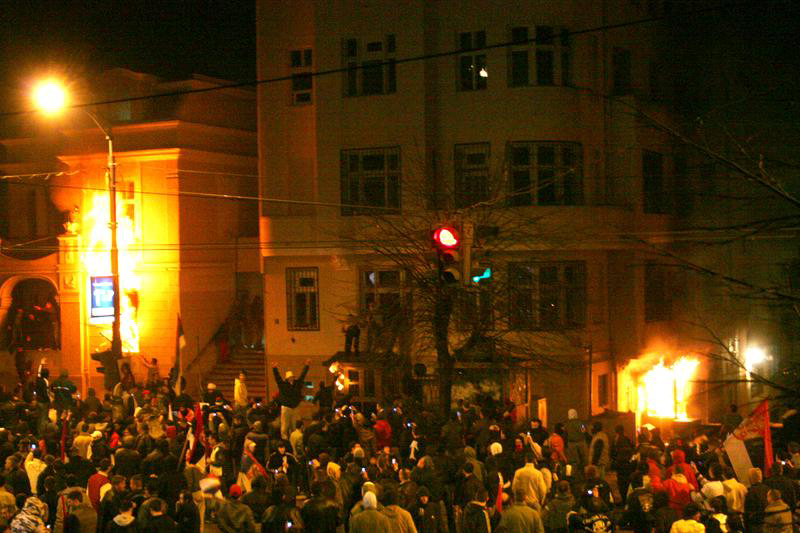
Multiple people were killed on Sunday, March 1, 2026, and more than 100 were hurt as violent demonstrations broke out across Pakistan and Iraq after Iran’s Supreme Leader Ayatollah Ali Khamenei died in U.S.-Israeli strikes. The deadliest unrest occurred in Karachi, Pakistan, where crowds attempted to overrun the American consulate.
In Karachi, security forces opened fire on demonstrators in Pakistan’s largest city, killing at least 10 and injuring over 50 as protesters shattered consulate windows, set a nearby police post ablaze, and briefly crossed the facility’s outer boundary. The intense clash accounted for nearly half of all reported casualties that day.
According to Summaiya Syed Tariq, a police surgeon at the city’s main government hospital, six bodies arrived initially, and four more critically injured individuals later died. Senior police official Irfan Baloch stated that protesters briefly breached the consulate’s perimeter before forces dispersed them, while denying claims that any part of the building was set alight.
The unrest expanded nationwide in Pakistan, where Shiite Muslims make up roughly 15 to 20 percent of the population of 250 million. In the northern Gilgit-Baltistan region, possibly around 14 people died in confrontations with police, according to local authorities, though exact figures vary. Protesters there attacked offices of the U.N. Military Observer Group and the U.N. Development Programme, burned police stations, and damaged charity buildings before troops were deployed and a curfew was enforced.
Two additional deaths occurred in Islamabad as police used tear gas and live ammunition while thousands of demonstrators attempted to march toward the U.S. Embassy. Authorities shut down all routes into the Red Zone, the fortified area that hosts diplomatic missions and government institutions.
President Asif Ali Zardari offered condolences to Iran after Khamenei’s death, saying: “Pakistan stands with the Iranian nation in this moment of grief and shares in their loss.”
Interior Minister Mohsin Naqvi called for restraint while acknowledging the widespread sorrow, urging citizens not to engage in vigilantism and to protest peacefully. He described the moment as a day of mourning for the Muslim Ummah and for both Pakistanis and Iranians.
Khamenei, aged 86, had served nearly 37 years as Iran’s Supreme Leader—making him the longest-serving head of state in the Middle East—and built a regional network of Iran-backed militias. His death reverberated throughout the Islamic world, especially within Shiite communities that regarded him as a spiritual figure.
In Iraq, security forces used teargas on hundreds of pro-Iran demonstrators who waved flags, hurled stones, and attempted to enter Baghdad’s Green Zone, home to the U.S. Embassy. The unrest followed U.S.-Israeli strikes that killed Khamenei and other leaders, targeting Iran-backed groups across the region.
Huge crowds also gathered in Lahore and Peshawar, where police used tear gas and batons to stop marches toward U.S. consulates. In Multan, a city in Punjab province, protesters held a peaceful demonstration condemning the United States and Israel. Mamoona Sherazi, attending the rally, told reporters: “God willing, we will never bow before America and Israel.”
The U.S. Embassy in Islamabad reported that it was monitoring ongoing protests at its consulates in Karachi and Lahore, along with planned demonstrations at the embassy in Islamabad and the consulate in Peshawar. It advised American citizens to follow local news, avoid crowds, and stay alert.
Pakistan’s government tightened security at U.S. diplomatic sites across the country. Sindh Province Interior Minister Ziaul Hassan Lanjar said that authorities would not permit disorder and urged people to voice their opinions peacefully.
Across the Middle East, the killing sparked widespread response. Tens of thousands of Hezbollah supporters and Shiite Muslims gathered in southern Beirut to honor Khamenei, waving flags and holding his portrait. In Yemen, pro-Houthi outlets claimed that a million people marched in Sanaa to show support for Iran.
Iran-aligned groups—including Hamas, the Houthis, Iraqi militias, and Hezbollah—issued statements mourning his death. Hezbollah’s secretary general, Naim Qassem, lauded Khamenei’s role in what Tehran calls the “axis of resistance” against U.S. and Israeli influence.
Khamenei’s death comes less than 18 months after Israel killed Hezbollah leader Hassan Nasrallah in a September 2024 airstrike on Beirut—another major blow to Iran’s regional influence and a symbolic loss for Shiite communities that viewed both men as icons of resistance.