
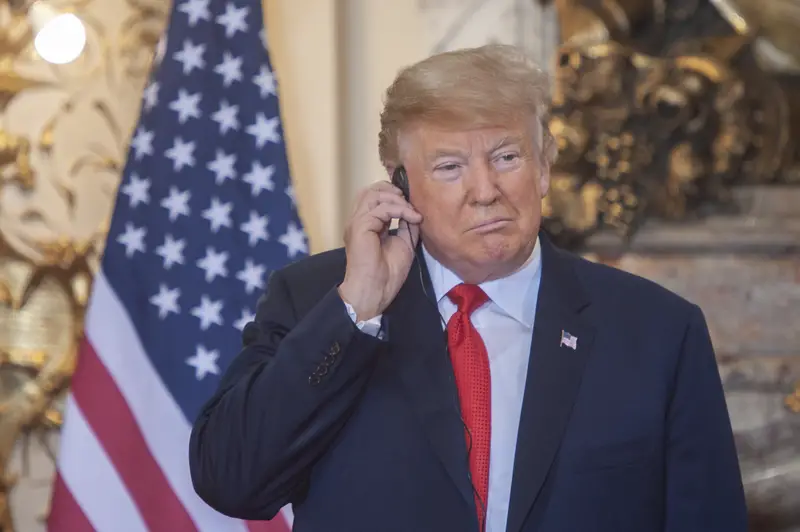
President Donald Trump appeared to hint at underwhelming economic numbers in a typo-laden social media post early Friday, Feb. 20, 2026. He disclosed weak GDP performance about 40 minutes before it was officially announced, while also aiming again at Federal Reserve Chair Jerome Powell.
“LOWER INTEREST RATES. ‘Two Late’ Powell is the WORST!!!” Trump wrote on Truth Social at 7:50 a.m. ET, seemingly misspelling his usual “Too Late” nickname for the Fed chair. His post landed just as the Commerce Department prepared to release fourth‑quarter figures showing growth had cooled to only 1.4 percent.
Trump’s premature message also blamed Democrats for the slowdown, saying the shutdown “cost the U.S.A. at least two points in GDP” and warning against similar funding standoffs in the future.
When the data became public at 8:30 a.m., it confirmed Trump’s gloomy preview. The economy expanded at an annual rate of 1.4 percent in the final quarter of 2025 — a steep drop from the prior quarter’s 4.4 percent and well below analysts’ forecasts of 2.5 percent to 3 percent. This marked a 3 percentage-point decline from the previous period.
The early disclosure was at least the second time Trump signaled economic indicators before they were officially published. OMB rules bar executive branch officials from commenting on sensitive data ahead of release and prohibit public statements until 30 minutes afterward. In January, Trump indirectly previewed payroll figures, leading the White House to concede an “inadvertent public disclosure of aggregate data.”
The soft GDP report undercut Trump’s economic narrative just days before his Feb. 24 State of the Union address. He has repeatedly credited himself for what he calls a “booming” economy, even telling a Georgia audience the day prior that he had “solved” affordability issues.
The slowing growth was partly due to the historic 43‑day government shutdown that began Oct. 1 and lasted into mid‑November. The Bureau of Economic Analysis estimated the shutdown trimmed real GDP growth by about one point, while the CBO predicted it could reduce annualized growth by as much as two points.
But the shutdown was not the only drag. Consumer spending, a core driver of U.S. economic activity, rose just 2.4 percent in the fourth quarter, down from a strong 3.5 percent in the third. The slowdown shows households are feeling financial strain despite the administration’s optimistic tone.
Joel Kan, vice president and deputy chief economist at the Mortgage Bankers Association, noted that higher‑income consumers continue to account for most spending, while lower‑income households struggle with higher costs and increased credit usage.
Adding to the administration’s challenges, a separate Commerce Department report indicated inflation ticked up in December. The PCE price index rose 2.9 percent over the prior year, nearly a full percentage point above the Fed’s 2 percent goal. Stubborn inflation makes it unlikely that Powell will lower interest rates as quickly as Trump wants.
The timing is politically difficult for Trump. His overall approval rating fell to 38 percent in the latest Reuters/Ipsos poll, down from roughly 50 percent when he took office in January 2025. Consumer confidence dropped 9.7 points to 84.5 in January 2026 — its lowest level since May 2014, and even weaker than during the COVID‑19 downturn.
For the full year 2025, GDP grew 2.2 percent, down from 2.8 percent in 2024. Despite steady growth overall, employers added only 181,000 jobs in 2025 — the smallest increase for any non‑recession year since 2003. The unemployment rate stood at 4.3 percent.
White House spokesperson Kush Desai attempted to cast the numbers in a positive light, claiming GDP “smashed” forecasters’ expectations and crediting the president’s tax cuts, deregulation, and tariffs for setting the stage for a stronger rebound in 2026.
Some indicators did reveal underlying resilience. Real final sales to private domestic purchasers — which reflect both business and household spending — increased 2.4 percent, consistent with post‑pandemic recovery patterns. Budget Lab executive director Martha Gimbel described economic activity as “reasonably solid,” saying, “This is not a disastrous report.”
Federal Reserve minutes from the January meeting showed policymakers are increasingly reluctant to cut interest rates in 2026. Some even argued rates could need to rise if inflation remains elevated. Chris Zaccarelli, chief investment officer at Northlight Asset Management, said the combination of tepid growth and persistent inflation is widening the divide between hawkish and dovish Fed officials.