
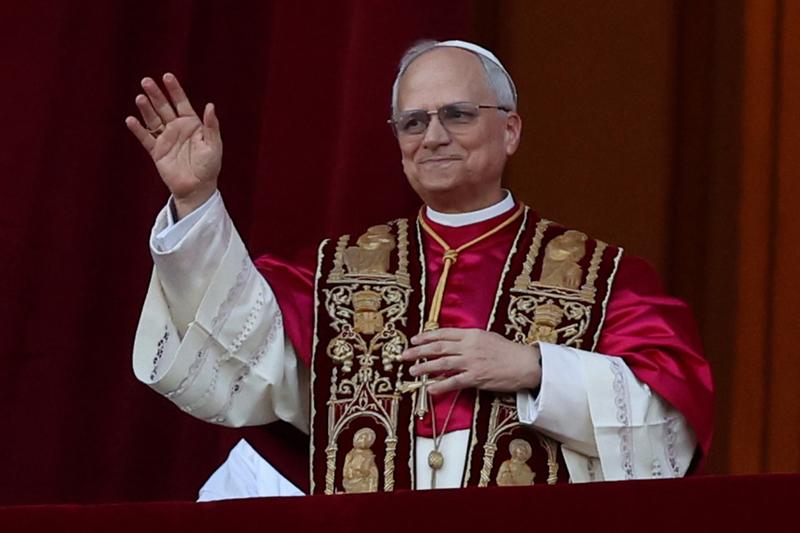
Pope Leo XIV issued a diplomatic rebuke to President Donald Trump on Monday, Feb. 16, 2026, turning down an invitation to join the administration’s controversial Board of Peace as the Vatican cautioned that the initiative could weaken the United Nations.
Cardinal Pietro Parolin, the Vatican’s Secretary of State and top diplomatic official, said the Holy See “will not participate in the Board of Peace because of its distinct nature, which he noted differs clearly from that of other nations.” The statement was made just three days before the board’s first scheduled meeting in Washington on Thursday, Feb. 19.
The pope, spiritual leader of 1.4 billion Catholics worldwide, received the invitation in January as Trump expanded the board’s focus beyond overseeing Gaza’s temporary administration. Trump leads the board with broad veto power and full authority over which nations may join, presenting it as a venue for addressing global conflicts and supervising Gaza’s reconstruction after the Israel-Hamas war.
“One concern is that at the international level it should above all be the UN that manages these crisis situations,” Parolin said. “This is one of the points on which we have insisted.”
The Vatican’s stance represents a significant diplomatic setback for Trump, who unveiled the Board of Peace concept last fall and formally launched it last month during the World Economic Forum in Davos. White House press secretary Karoline Leavitt described the Vatican’s decision as “deeply unfortunate,” defending the administration’s broad reconstruction plans for Gaza.
“I don’t think that peace should be partisan or political or controversial,” Leavitt said. “This is a legitimate organization where there are tens of member countries from around the world.”
Pope Leo XIV, the first American pontiff, has become an outspoken critic of multiple Trump administration policies. He has regularly denounced civilian suffering and conditions in Gaza following Israel’s response to the Hamas-led attack that killed roughly 1,200 people in Israel. The Board of Peace has urged Hamas to disarm and has coordinated rebuilding plans, with Trump announcing $5 billion in commitments from board members to support reconstruction.
The Vatican’s hesitation aligns with concerns expressed by several Western nations. Italy and the European Union planned to attend Thursday’s meeting merely as observers and have not joined. France, Denmark, Norway, Slovenia, Sweden, and the United Kingdom have all either rejected invitations or voiced strong skepticism about the effort.
Human rights groups have criticized the board’s structure, arguing that Trump overseeing a body tasked with administering a foreign territory resembles a colonial model. Critics also highlight the limited Palestinian representation. Trump holds exclusive veto authority and sole power to invite members, and his position as chair has no term limit—the charter says he may serve indefinitely, including after leaving office.
The board’s administrative offices operate from the newly renamed Donald J. Trump Institute of Peace, formerly the U.S. Institute of Peace. Russia, China, and Turkey were invited, though Russia announced this week it would not attend Thursday’s summit. While some Middle Eastern partners have joined, most Western nations remain cautious over fears the board could undermine the U.N. framework.
The Vatican maintains a wide diplomatic presence and holds permanent observer status at the United Nations. The pope rarely participates directly in such international bodies, typically favoring established diplomatic channels and the broader U.N. system.
A senior Trump administration official said the pope and Vatican “are welcome to join the many other nations who are committed to the Board of Peace,” though the official declined to provide details about diplomatic communications.
President Trump convened the board’s first session on Thursday, Feb. 19, at the U.S. Institute of Peace in Washington, D.C., bringing together representatives from more than 40 nations for a three-hour summit focused on Gaza’s reconstruction and regional stability. Trump pledged a $10 billion U.S. contribution, with other member states offering around $7 billion more. Five nations—Albania, Indonesia, Kazakhstan, Kosovo, and Morocco—agreed to supply troops for a 20,000-member International Stabilization Force, while Egypt and Jordan committed to training 12,000 Palestinian police officers. Initial deployment is planned for Rafah in southern Gaza, where rebuilding will begin.
In his remarks, Trump also addressed escalating tensions with Iran, saying a decision on possible military action would likely be made within “10 to 15 days,” adding, “We may have to take it a step further, or we may not. Maybe we’re going to make a deal.”
The Board of Peace—characterized by Trump as a potential successor to the United Nations—was formally created in January 2026 at the World Economic Forum in Davos, with 25 of 62 invited nations signing its founding charter.
The Vatican’s refusal to take part underscores growing global tension over how to address the Gaza situation and whether Trump’s new body will collaborate with or compete against long-standing institutions like the United Nations. With Pope Leo XIV joining other skeptics, Trump’s Board of Peace faces a difficult path to gaining legitimacy among key Western allies.