
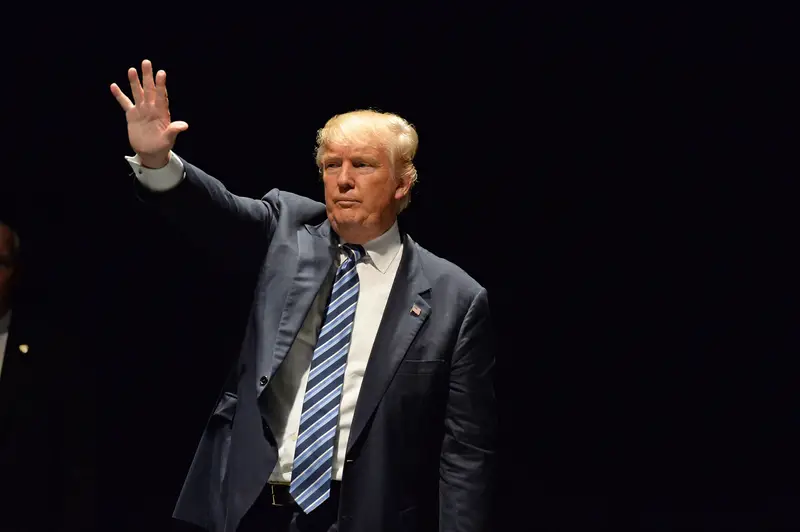
President Donald Trump, 79, struggled visibly as he descended the stairs from Air Force One on Wednesday, Jan. 21, 2026, after arriving in Davos, Switzerland, for the World Economic Forum. The president appeared exhausted following a flight marred by mechanical problems and significant delays that added more than two hours to his journey.
The president’s trip began with an electrical issue on Air Force One that forced the aircraft to return to Washington, D.C., on Tuesday night. After switching planes, Trump departed again just after 1 a.m. Wednesday, finally touching down in Zurich on Wednesday morning. From there, he traveled by helicopter to Davos for his scheduled address to world leaders.
Video footage showed Trump descending the plane’s steps with caution, holding the handrail as he slowly made his way to the tarmac before boarding a nearby helicopter for the final part of his trip.
Trump’s visit to Davos followed an intense series of public appearances. On Monday night, Jan. 19, he was at the college football championship game, which ended in the early morning hours. Later that Tuesday, Jan. 20, he held a 104-minute press briefing at the White House before getting ready for his overseas trip.
During his address at the World Economic Forum, many noticed that the president looked tired, with noticeable circles under his eyes. The strain of his recent schedule showed as Trump spoke to global leaders about trade issues and foreign affairs.
The president’s visible fatigue has intensified worries about the demanding pace of his schedule.
The error came as Trump continued to push for the acquisition of Greenland, a Danish autonomous territory. While he ruled out using military force during his Davos speech, he threatened economic pressure through tariffs—a move that strained ties with European allies and sparked concerns about NATO unity.
During the trip to Davos, White House Chief of Staff Susie Wiles announced a major change to the president’s travel schedule. Trump has said he will scale back his international appearances and shift his attention to domestic trips as the November midterm elections approach.
Wiles announced aboard Air Force One that the president plans to visit a different city each week, unveiling a revised approach that has Trump traveling extensively across the United States instead of focusing on frequent overseas trips.
The domestic tour will include a stop in Iowa, where Trump is expected to deliver remarks centered on economic issues. This shift marks a realignment of priorities for an administration that had originally envisioned a more prominent international agenda in its second term.
The move to scale back foreign travel comes as the president faces growing questions about his physical endurance and mental sharpness. Critics have been scrutinizing his public appearances closely, noting signs of fatigue.
During Tuesday’s extended White House briefing, Trump veered off topic to reminisce about his baseball days at Cunningham Park. He also launched into a lengthy aside about mental health facilities, specifically referencing Creedmoor Psychiatric Hospital, in a tangent that stretched several minutes.
The World Economic Forum in Davos has traditionally been an important venue for U.S. presidents to meet with global business leaders and foreign officials. The annual gathering draws heads of state, top executives, and policymakers to discuss economic developments and major global issues.
Mechanical issues with Air Force One created an unexpected complication during what was already an arduous trip. Though returning to Washington to change aircraft was the safe choice, the delay disrupted the president’s rest and added several hours to his travel time.
The renewed emphasis on domestic travel reflects both concerns about the president’s stamina and strategic considerations ahead of the midterm elections. Midterms often pose difficulties for the party in power, and Trump’s team appears to be prioritizing direct voter outreach over international engagements during this pivotal period.
As the administration shifts to a travel schedule centered more on domestic stops, questions remain about how well the president can juggle the responsibilities of the job alongside the natural challenges that come with age. Wiles’s announcement indicates that Trump’s advisers understand the need to pace his appearances more strategically, even as they present the change as a campaign-driven move rather than one shaped by physical constraints.