
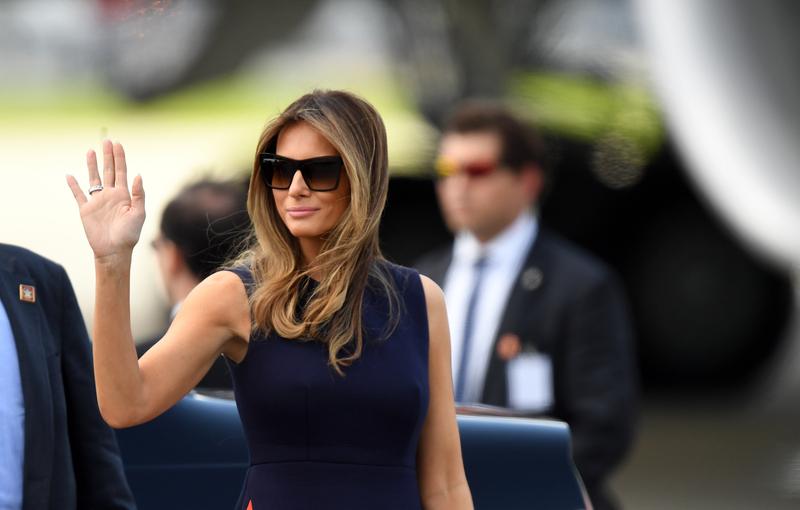
When Melania Trump took her seat in the First Lady’s Box at the 2026 State of the Union on Feb. 24, something was missing: coordination with her husband. For the first time in modern memory, the President and First Lady brought entirely separate guest lists to the nation’s most-watched political address — Donald Trump inviting guests reflecting his policy agenda, Melania independently inviting children representing her own foster care and AI education platforms. It was the most visible symbol yet of a marriage that has long operated on parallel tracks.
That distance is not new. It traces back to election night 2024 in West Palm Beach, when Trump thanked his ‘beautiful wife, Melania’ — and as he moved in to kiss her, she subtly turned her head, offering her cheek instead. What has changed is the scale. The distance is no longer just physical. It is now institutional.
Throughout the 2024 race, Melania’s absence was striking. As PBS reported, she “largely avoided public events, missing high-profile moments like former President Donald Trump’s Super Tuesday celebration and his 78th birthday party.” She skipped every day of his monthlong hush-money trial—including the verdict. In Michael Wolff’s book “All or Nothing,” he recounts that when the campaign asked her to join Trump after his first indictment, she “just laughed” and replied, “Nice try.”
In early 2026, Melania began moving on her own terms — not alongside her husband, but independently of him. On Feb. 26, 2026, she chaired a meeting of the United Nations Security Council, becoming the first sitting American First Lady ever to preside over the 15-member body. She used the platform to advocate for education as a path to global peace — an agenda entirely her own. Days earlier, she had facilitated the return of Russian and Ukrainian children separated by war to their families, the third such reunification she has brokered. Neither event involved her husband directly.
During a 2017 state visit to Tel Aviv, Melania appeared to brush away Trump’s hand on the tarmac — an incident that went viral and that she later addressed in her memoir, citing red-carpet protocol.
One of the most revealing clues about the transactional nature of their marriage emerged in 2017. According to Mary Jordan’s “The Art of Her Deal,” Melania postponed her move to the White House to renegotiate her prenuptial agreement. Jordan wrote that Melania insisted on written assurances that their son Barron would have financial and inheritance considerations comparable to Trump’s three oldest children.
When allegations of Trump’s affair with Stormy Daniels surfaced in 2018, Melania “didn’t take it lightly,” former White House press secretary Stephanie Grisham said. She “refused to walk to Marine One with him because she didn’t want to resemble Hillary Clinton standing by her man.” The two traveled separately to the 2018 State of the Union. Yet according to former adviser Stephanie Winston Wolkoff, Melania’s private reaction was simply: “It’s politics.”
When Trump’s second term began in January 2025, Melania was largely absent from Washington. She spent fewer than 14 days at the White House in the first 108 days of the administration — prompting historian Katherine Jellison to tell the New York Times: “We haven’t seen a first lady this low-profile since Bess Truman.” Even at Mar-a-Lago, People magazine noted she “keeps to herself,” joining her husband for dinner only ‘occasionally.’ Meanwhile, Trump physically demolished the East Wing — the space historically associated with First Ladies — while she remained away.
Perhaps most revealing: CNN reported that one of the few political events Melania attended in 2024 came with a six-figure paycheck. Trump’s financial disclosure showed she was paid $237,500 for speaking at a Log Cabin Republicans fundraiser—“a highly unusual decision for a candidate’s spouse,” CNN noted. Former aide Stephanie Grisham told CNN, “She’s been so disconnected from this campaign and so absent that I could see her saying, ‘If I’m going to put my time in, I will get paid for this.’”
“I’m a very private person and a very selective person—what I do, what I don’t do, when I talk, when I don’t talk. And that’s my choice, and nobody is in charge of me,” Melania said on Fox News while discussing her documentary.
The $40 million Amazon documentary deal — over which she retained full editorial authority, including music and color correction — became reality on January 30, 2026, when the film Melania was released in 2,000 theaters domestically and 5,000 worldwide. It premiered the night before at the Kennedy Center. Critics were largely unkind, calling it self-promotional, but the film grossed $16.4 million worldwide by late Feb. 2026. Combined with her memoir, her cryptocurrency ventures, and digital collectibles, the project confirmed what insiders had long suspected: Melania has built a financial identity entirely independent of her husband’s political operation.
As Donald Trump operates from the Oval Office surrounded by officials and foreign leaders, his wife is increasingly visible — just never beside him. She chairs UN Security Council meetings. She brokers diplomatic reunifications. She releases films on her own terms and brings her own guests to the State of the Union. The tower at Mar-a-Lago remains. But in 2026, Melania Trump is no longer simply absent. She has built a parallel existence — public enough to matter, independent enough to be entirely her own. Whether that represents a modern woman’s autonomy or a deliberate, long-planned exit strategy playing out in slow motion, one thing is no longer in question: this is not a traditional First Lady, and this has never been a traditional marriage.